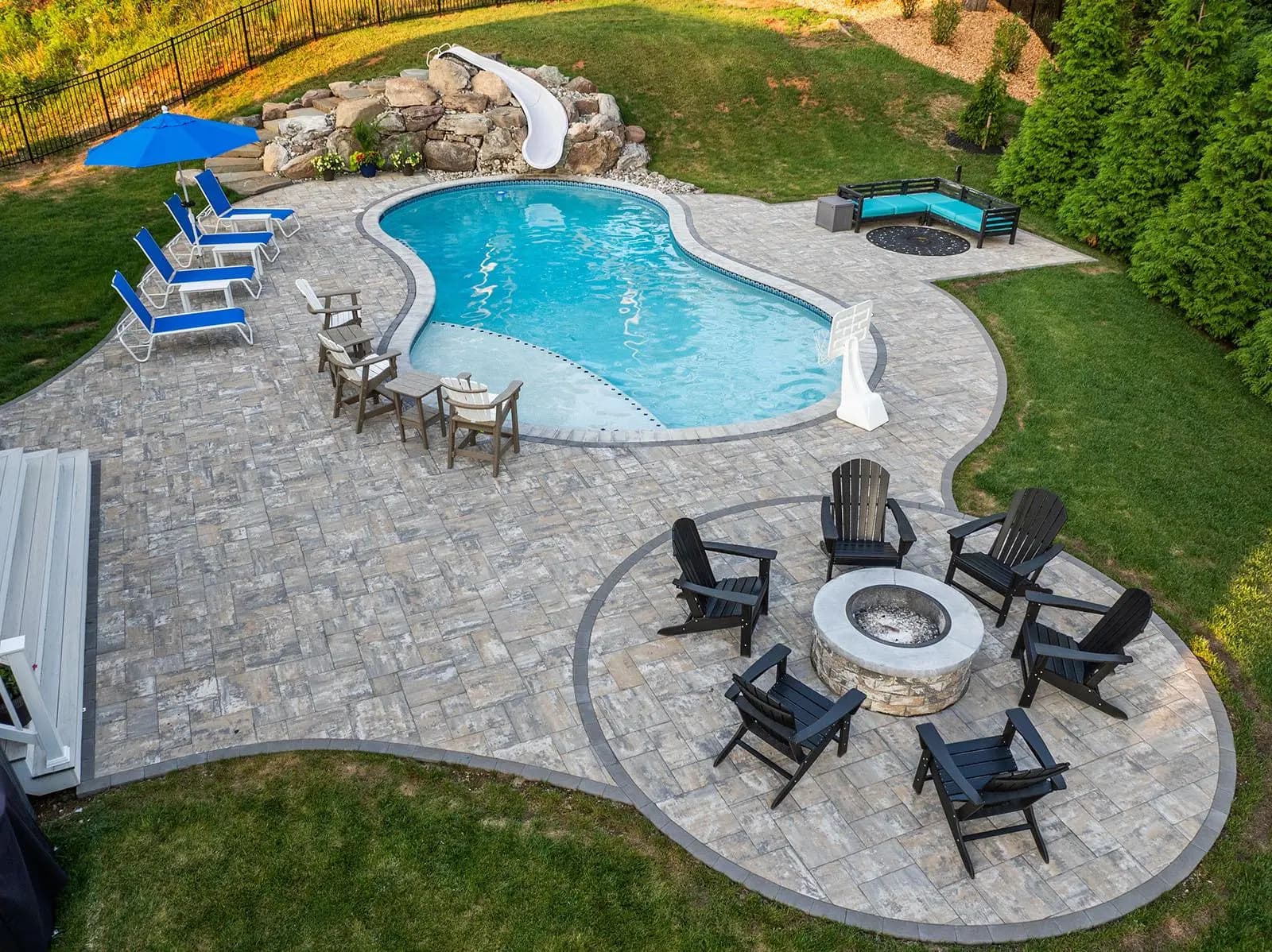
Custom inground pool built by K&D Contracting in Fredericksburg VA

Pool FAQ

Pool Questions, Answered

Straight answers on cost, materials, timelines, permits, and what it takes to build a pool in Fredericksburg and Northern Virginia.

Pool questions answered

We pulled every question from our guides, service pages, and location pages into one place. Each answer links back to the full guide so you can go as deep as you need.

Is K&D Pools licensed and insured?

Yes. K&D Pools is a licensed Virginia contractor and carries the required insurance coverage for residential pool construction. Because the crew self-performs the work, one accountable team stands behind the entire project.

Read Moreabout Is K&D Pools licensed and insured?
What area does K&D serve?

K&D builds custom inground pools and complete backyards throughout the Fredericksburg metro, including Fredericksburg City, Spotsylvania County, and Stafford County, plus the communities along the I-95 corridor. They're based in Fredericksburg, so most work sites are a short drive away.

Read Moreabout What area does K&D serve?

Can I reach K&D after the pool is built?

Yes. K&D is a local Fredericksburg business, not a national franchise or a seasonal operation. If something needs attention after handover, you reach the same crew that built your pool rather than a customer service line in another state.

Read Moreabout Can I reach K&D after the pool is built?

Do you self-perform or use subcontractors?

K&D self-performs the core work: excavation, structural, plumbing, electrical rough-in, tile and coping, deck construction, and features. Using their own crew means one point of accountability and no handoffs between separate companies for the work that matters most.

Read Moreabout Do you self-perform or use subcontractors?

How long has K&D been building pools?

K&D has been building in the Fredericksburg area for years and works in the region every week. Rather than lean on a number, the better proof is the 4.8-star Google rating from 75 reviews and the work standing in backyards across Spotsylvania and Stafford.

Read Moreabout How long has K&D been building pools?

Why choose a local builder over a national franchise?

A local builder develops a relationship with county inspectors, learns the specific soil and drainage quirks of the region, and has a community reputation at stake. K&D is based in Fredericksburg, does most of its business within an hour's drive, and stands behind the work long after the fill date.

Read Moreabout Why choose a local builder over a national franchise?

Do I have to use K&D for both the pool and the deck?

No, but using one team for both saves you coordination time and avoids common problems: decks built at the wrong height, drainage that wasn't accounted for in the pool design, and electrical that wasn't roughed in before concrete was poured. K&D includes the deck and features in the original project so everything is planned together.

Read Moreabout Do I have to use K&D for both the pool and the deck?

What deck materials do you build with?

K&D builds pool decks in brushed concrete, exposed aggregate, pavers, and natural stone. The right material depends on your budget, the look you're going for, and how the deck surface needs to perform in Virginia's freeze-thaw climate. They'll walk you through the options during design.

Read Moreabout What deck materials do you build with?

Can I add a pergola to my pool project?

Yes. K&D builds pergolas, pavilions, and covered structures as part of pool projects. Planning the shade structure alongside the pool means the placement, the electrical, and the overall layout are coordinated from the start.

Read Moreabout Can I add a pergola to my pool project?

Does K&D handle pool fencing as well?

Yes. K&D builds the required safety fencing as part of the project and pulls the county permits for it. Virginia requires pool barriers, and the counties in the Fredericksburg area have specific code requirements that K&D handles directly.

Read Moreabout Does K&D handle pool fencing as well?

How do water features get plumbed?

Water features are plumbed into the pool's circulation system during the build so they're properly sized for the pump and filter. Running the plumbing after the deck is already poured creates a much harder and more expensive job. K&D rough-ins all the water features as part of the initial build.

Read Moreabout How do water features get plumbed?

Can you work with a sloped backyard?

Yes, and sloped backyards are common in the Fredericksburg area. K&D assesses the grade during the site visit and designs the pool, deck, and drainage to work with the terrain. Retaining walls, level changes, and drainage solutions are all part of the planning conversation.

Read Moreabout Can you work with a sloped backyard?

How long does it take to build a custom inground pool in Fredericksburg?

Fiberglass pools are often swimmable within a few weeks of permits clearing, since the shell is pre-made. A custom gunite pool usually takes longer, often eight to twelve weeks or more, because the structure is built and cured on site. K&D gives you a realistic, project-specific timeline before any work starts.

Read Moreabout How long does it take to build a custom inground pool in Fredericksburg?

What does a custom pool cost in the Fredericksburg area?

Pool costs vary widely based on size, type, features, and site conditions. K&D gives you a real, project-specific number after seeing your yard rather than a teaser estimate that climbs. The quote covers permits, engineering, the pool, and the surrounding deck and features.

Read Moreabout What does a custom pool cost in the Fredericksburg area?

Do you build both gunite and fiberglass pools?

Yes. K&D builds both with their own in-house crew. They'll walk you through which type fits your goals, your timeline, and your yard during the design consultation, with no pressure toward one or the other.

Read Moreabout Do you build both gunite and fiberglass pools?

Will I see a design before excavation starts?

Yes. K&D produces a custom 3D rendering during the design phase so you can see the pool shape, deck layout, and features before any dirt moves. You refine it together until the design is exactly what you want.

Read Moreabout Will I see a design before excavation starts?

How does Virginia's clay soil affect the pool build?

Clay soil holds water and shifts with seasonal temperature changes, so the shell has to be engineered for that movement and backfilled correctly. K&D designs and builds with local soil conditions in mind, which is part of why hiring a local crew with regional experience matters.

Read Moreabout How does Virginia's clay soil affect the pool build?

How fast can a fiberglass pool be installed?

After permits clear and the site is prepped, K&D can often set and finish a fiberglass shell in two to four weeks, since the shell is manufactured off site. The total project timeline depends on deck scope, access, and county permit timelines, but it's typically much shorter than a gunite build.

Read Moreabout How fast can a fiberglass pool be installed?

Do fiberglass pools hold up to Virginia winters?

Yes, when installed correctly. The shell is engineered to handle freeze-thaw movement, and the key is proper base preparation, backfill, and drainage. K&D sets a compacted gravel base and manages the backfill so the shell stays stable through seasonal ground shifts.

Read Moreabout Do fiberglass pools hold up to Virginia winters?

Is a fiberglass pool harder to maintain than gunite?

Fiberglass is generally easier to maintain. The smooth, non-porous gelcoat resists algae, so owners typically use fewer chemicals and spend less time cleaning than with a plaster or rougher gunite surface. Standard water chemistry and equipment maintenance still apply.

Read Moreabout Is a fiberglass pool harder to maintain than gunite?

What shapes and sizes are available for fiberglass pools?

Fiberglass shells come in a range of manufacturer-set shapes and sizes, from rectangles to kidney shapes to freeform designs. There are practical limits on width and depth because the shell ships as one piece. If you need a very large pool or a fully custom shape, gunite is the better option.

Read Moreabout What shapes and sizes are available for fiberglass pools?

Can I add a spa with a fiberglass pool?

Some fiberglass shell designs include an integrated spa or can be paired with a separate fiberglass spa unit. If you want a fully custom spa with specific dimensions or features, a gunite build gives you more control. K&D will walk you through what's possible with the shell options available.

Read Moreabout Can I add a spa with a fiberglass pool?

Do fiberglass pools crack or have structural problems?

Properly installed fiberglass pools are quite durable. Problems occur when the shell is set on a poor base, backfilled with the wrong material, or installed without accounting for local soil and drainage. K&D takes the prep work seriously, which is where most fiberglass failures originate.

Read Moreabout Do fiberglass pools crack or have structural problems?

Does the gelcoat surface ever need to be replaced?

The gelcoat surface can last fifteen to twenty-five years or more with proper water chemistry. If it degrades it can be refinished, but it's a less frequent and less involved process than replastering a gunite pool. Keeping your water balanced is the main thing that extends gelcoat life.

Read Moreabout Does the gelcoat surface ever need to be replaced?

How long does a gunite pool last?

A properly built gunite pool can hold its structural integrity for several decades. The interior finish is typically resurfaced every ten to fifteen years, but the concrete shell itself outlasts almost any other pool type when it's engineered correctly and maintained with standard water care.

Read Moreabout How long does a gunite pool last?

How long does it take to build a gunite pool?

A typical custom gunite pool takes eight to fourteen weeks from excavation to finished water, depending on design complexity, deck scope, and the county inspection schedule. Permit timelines vary by county, but K&D files early and manages the schedule around them.

Read Moreabout How long does it take to build a gunite pool?

Is gunite more expensive than fiberglass?

Not necessarily. Smaller, simpler projects sometimes favor fiberglass on first cost because the shell is factory-built. Larger or more custom projects often favor gunite because you're not paying a premium for custom molds. The honest comparison is a real quote for your specific yard.

Read Moreabout Is gunite more expensive than fiberglass?

Can you add a spa to a gunite pool?

Yes. Integrated spas are one of the most common custom features in gunite pools. K&D builds the spa and the pool as one connected structure so the plumbing, equipment, and spillover all work together rather than being patched in separately.

Read Moreabout Can you add a spa to a gunite pool?

Does gunite hold up to Virginia's freeze-thaw winters?

Yes, when it's engineered for local conditions. K&D accounts for Virginia clay, seasonal ground movement, and freeze-thaw cycles in the structural design and backfill approach. A pool built to local conditions handles winters without structural issues.

Read Moreabout Does gunite hold up to Virginia's freeze-thaw winters?

What interior finish options are available for gunite pools?

Gunite pools can be finished with plaster (traditional and cost-effective), quartz aggregate (more durable and available in many colors), or glass bead finishes (the smoothest and longest-lasting). K&D walks you through the options during design and recommends the finish that fits your priorities.

Read Moreabout What interior finish options are available for gunite pools?

Do you handle gunite pool permits in all three counties?

Yes. K&D pulls permits and manages county inspections in Fredericksburg, Spotsylvania, and Stafford. They prepare the required structural engineering drawings and coordinate with county offices directly, so you don't have to learn each county's process.

Read Moreabout Do you handle gunite pool permits in all three counties?

How long does the whole pool build process take?

The total timeline from design to first swim depends on the pool type, county permit processing, and scope. Fiberglass pools can often be finished in six to ten weeks after permits clear. Gunite pools typically run twelve to eighteen weeks from excavation to finished deck. K&D gives you a project-specific timeline at the start.

Read Moreabout How long does the whole pool build process take?

When do I need to make design decisions?

The important design decisions happen in Stage 1, during the 3D design phase. Shape, size, depth profile, features, and deck layout are all finalized before any work starts. Changes after excavation are expensive and may delay the build, so K&D takes time upfront to get the design right.

Read Moreabout When do I need to make design decisions?

Who handles the permit applications?

K&D files all permit applications, prepares the structural engineering drawings, and coordinates county inspections in Fredericksburg, Spotsylvania, and Stafford. You don't deal with the county process yourself.

Read Moreabout Who handles the permit applications?

Can I build a pool on a small Old Town Alexandria lot?

Sometimes yes, but it depends on the lot dimensions, setbacks, and the presence of adjacent structures or shared foundations. K&D does a real site assessment before we tell you what is feasible. We are honest if a lot is too constrained.

Read Moreabout Can I build a pool on a small Old Town Alexandria lot?

Who handles pool permits in Alexandria?

The City of Alexandria has its own independent building department. All pool permits are filed with the City, not with Fairfax County. K&D prepares and submits the complete permit package.

Read Moreabout Who handles pool permits in Alexandria?

What type of pool is best for a small Alexandria lot?

Fiberglass pools are often the better fit for small City of Alexandria lots. The installation is faster, limiting disruption to tight urban yards, and the fixed shell sizes happen to work well when the available footprint is already defined by setbacks. We go over both options at the site visit.

Read Moreabout What type of pool is best for a small Alexandria lot?

How long does pool permitting take in Alexandria?

Alexandria's building department is thorough and can take 6 to 12 weeks for plan review. Submitting a complete, correct package the first time avoids revision delays. K&D's permit packages are prepared to the City's standards.

Read Moreabout How long does pool permitting take in Alexandria?

What does a pool cost in Alexandria, VA?

Alexandria projects often run higher than suburban builds because of the additional permitting complexity, tighter construction logistics in dense neighborhoods, and premium materials expectations. A compact fiberglass pool with a paver surround typically starts around $75,000 to $90,000. Gunite pools with full deck work start higher. We provide a line-item quote after the site visit.

Read Moreabout What does a pool cost in Alexandria, VA?

Does K&D Pools build in Fairfax, VA?

Yes. Fairfax County and the City of Fairfax are within our service area. K&D drives up from Fredericksburg, roughly 60 to 75 minutes, and we take on builds throughout the county.

Read Moreabout Does K&D Pools build in Fairfax, VA?

What are the permit requirements for a pool in Fairfax County?

Fairfax County requires building permits for inground pools, including structural engineering drawings, equipment energy compliance documentation, and inspections at excavation, steel, shell, plumbing, and final stages. K&D prepares and submits the full permit package.

Read Moreabout What are the permit requirements for a pool in Fairfax County?

How long does a custom pool build take in Fairfax?

Fairfax County plan review typically takes 4 to 10 weeks. After permit, gunite pools take 12 to 18 weeks to build. Fiberglass pools can be done in 5 to 9 weeks post-permit. Timeline varies with project complexity.

Read Moreabout How long does a custom pool build take in Fairfax?

What does a custom inground pool cost in Fairfax, VA?

Gunite pools in Fairfax County typically start in the $90,000 to $120,000 range with a standard deck. Premium finishes, travertine or bluestone decking, water features, and full backyard renovation push costs higher. We provide a line-item quote after the site visit.

Read Moreabout What does a custom inground pool cost in Fairfax, VA?

Does K&D Pools build in Haymarket, VA?

Yes. Haymarket and western Prince William County are within our service area. K&D drives from Fredericksburg, roughly 55 to 70 minutes via I-95 and VA-234, for both site visits and builds.

Read Moreabout Does K&D Pools build in Haymarket, VA?

How does Haymarket soil affect pool construction?

Western Prince William County soil runs toward sandy loam with less heavy clay than eastern parts of the county. This generally means better drainage and less seasonal soil movement around the pool shell. It is one of the reasons Haymarket builds tend to go smoothly.

Read Moreabout How does Haymarket soil affect pool construction?

What pool types does K&D recommend for Haymarket lots?

With the larger lots common in Haymarket, both gunite and fiberglass are practical options. Gunite gives you full design freedom for custom shapes, integrated spas, and specific dimensions. Fiberglass installs faster and has a simpler long-term maintenance profile. We walk through both options at the site visit so you can choose based on your design goals and timeline.

Read Moreabout What pool types does K&D recommend for Haymarket lots?

How long does a pool project take in Haymarket?

Prince William County plan review typically takes 4 to 8 weeks. After permit, a gunite pool takes 10 to 16 weeks to complete. Fiberglass pools can finish in 4 to 8 weeks post-permit. If HOA review runs parallel to the county permit, it usually does not add time to the overall schedule.

Read Moreabout How long does a pool project take in Haymarket?

What does a custom pool cost in Haymarket, VA?

Gunite pools with a standard concrete or paver deck in Haymarket typically start around $85,000 to $110,000. Full outdoor living projects with outdoor kitchen, pergola, and premium decking run higher. Fiberglass pools start lower. We provide line-item quotes after the site visit.

Read Moreabout What does a custom pool cost in Haymarket, VA?

Does K&D Pools serve Manassas, VA?

Yes. Manassas and the surrounding Prince William County area is within our service area. We make the drive up from Fredericksburg, typically 50 to 65 minutes, for site visits and builds.

Read Moreabout Does K&D Pools serve Manassas, VA?

Which jurisdiction handles pool permits in Manassas?

Your specific address determines whether you permit through the City of Manassas, the City of Manassas Park, or Prince William County. K&D identifies the correct entity during the site assessment and files the permit package accordingly.

Read Moreabout Which jurisdiction handles pool permits in Manassas?

Can K&D build a pool on a small in-town Manassas lot?

Yes. City of Manassas lots in older neighborhoods can be 0.15 to 0.25 acres. We design to the actual setback requirements for your jurisdiction and work within the available footprint. Smaller lots often benefit from a compact fiberglass pool or a custom gunite design optimized for the specific yard geometry.

Read Moreabout Can K&D build a pool on a small in-town Manassas lot?

How long does a pool build take in Manassas?

Plan review in the Manassas jurisdictions typically takes 3 to 8 weeks. After permit, a gunite pool takes 10 to 16 weeks to complete. A fiberglass pool installs faster, usually 4 to 8 weeks post-permit.

Read Moreabout How long does a pool build take in Manassas?

Do I need to worry about the National Battlefield proximity?

Manassas National Battlefield Park borders certain neighborhoods. Most residential properties are not affected by park regulations, but some may have county zoning overlays or deed restrictions. K&D checks the zoning and deed records for your parcel before finalizing the design.

Read Moreabout Do I need to worry about the National Battlefield proximity?

What does a custom pool cost in Manassas?

Custom gunite pools in this area typically start in the $80,000 to $110,000 range with a standard concrete deck. Fiberglass pools start lower. Exact pricing depends on size, features, site conditions, and deck scope. We provide a line-item quote after the site visit so you have a clear picture before signing anything.

Read Moreabout What does a custom pool cost in Manassas?

Do you build pools throughout Spotsylvania County?

Yes. K&D builds custom inground pools across Spotsylvania, from the subdivisions near Fredericksburg to the communities around Spotsylvania Courthouse and out toward Lake Anna and Locust Grove. They're based nearby, so distance is rarely a factor.

Read Moreabout Do you build pools throughout Spotsylvania County?

What is the pool permit process in Spotsylvania?

Spotsylvania County requires a building permit and a separate electrical permit for inground pools, along with structural engineering drawings and a compliant safety barrier or fence. K&D handles all permit applications, engineering, and inspections directly with the county.

Read Moreabout What is the pool permit process in Spotsylvania?

Can I build a larger pool on a big Spotsylvania lot?

Yes. The larger lots common in Spotsylvania give you room for a substantial pool, a wide deck, water features, and an outdoor living area. K&D designs the project to use the space well while planning grade, drainage, and access from the start.

Read Moreabout Can I build a larger pool on a big Spotsylvania lot?

How does Spotsylvania's clay soil affect a pool build?

Heavy clay holds water and moves with Virginia's freeze-thaw cycles, which puts lateral pressure on in-ground structures and affects drainage. K&D designs the pool, base, backfill, and drainage system with local soil conditions in mind from the start of the project.

Read Moreabout How does Spotsylvania's clay soil affect a pool build?

How long does a pool build take in Spotsylvania?

Fiberglass pools can often be swimmable within a few weeks of permits clearing, while gunite pools typically run eight to fourteen weeks from excavation. County permit timelines factor in too, which is why K&D files early. You get a project-specific timeline up front.

Read Moreabout How long does a pool build take in Spotsylvania?

Do I need HOA approval for a pool in Stafford?

Many Stafford neighborhoods require HOA architectural review in addition to Stafford County building permits. K&D handles the county permit and helps prepare the documentation that HOA review committees typically want, so you're not managing two separate approval processes on your own.

Read Moreabout Do I need HOA approval for a pool in Stafford?

What is the pool permit process in Stafford County?

Stafford County requires a building permit and a separate electrical permit for inground pools, plus structural engineering drawings and a code-compliant safety barrier. K&D files the permits, prepares the engineering, and coordinates the county inspection schedule directly. You don't deal with the county office yourself.

Read Moreabout What is the pool permit process in Stafford County?

Can you build a pool on a smaller Stafford subdivision lot?

Yes. K&D plans for limited excavation access, setback constraints, and equipment placement early in the design process. Tighter lots require more upfront planning but don't prevent a great pool build, and integrated deck and fencing planning keeps the finished yard looking complete.

Read Moreabout Can you build a pool on a smaller Stafford subdivision lot?

Is gunite or fiberglass better for a tight Stafford lot?

Both work well in Stafford. Fiberglass installs faster and requires less on-site construction time, which suits tighter yards and shorter disruption windows. Gunite opens up more design flexibility for larger lots or highly custom designs. K&D gives you an honest recommendation after seeing your specific property.

Read Moreabout Is gunite or fiberglass better for a tight Stafford lot?

How long does a pool build take in Stafford?

Fiberglass pools can often be swimmable within a few weeks of permits clearing, while gunite pools typically run eight to fourteen weeks from excavation. HOA review and county permit timelines factor in, which is why K&D starts the paperwork early. You get a project-specific timeline up front.

Read Moreabout How long does a pool build take in Stafford?

How far is K&D from Stafford?

K&D is based in Fredericksburg, a short drive from most Stafford work sites. They build in Stafford regularly and are familiar with the county permit office, the local soil conditions, and the HOA review processes in many Stafford neighborhoods.

Read Moreabout How far is K&D from Stafford?

Does K&D Pools build in Woodbridge, VA?

Yes. Woodbridge and the surrounding Prince William County area is within our regular service radius. K&D drives up from Fredericksburg, typically a 45 to 55 minute trip via I-95.

Read Moreabout Does K&D Pools build in Woodbridge, VA?

Do I need HOA approval before starting a pool in Woodbridge?

Many communities in Woodbridge, including Lake Ridge, Cardinal Forest, and Occoquan Overlook, require HOA architectural review before you can pull a county permit. We factor HOA review time into the project schedule and can provide documentation the HOA typically requests.

Read Moreabout Do I need HOA approval before starting a pool in Woodbridge?

How does clay soil affect pool construction in Woodbridge?

Clay-heavy soil is common throughout Prince William County. It holds moisture and can shift seasonally. K&D engineers the pool shell and footer design to the specific soil conditions on your lot. Gunite pools are particularly well-suited to this geology.

Read Moreabout How does clay soil affect pool construction in Woodbridge?

How long does it take to build a pool in Woodbridge?

A gunite pool typically takes 10 to 16 weeks from permit approval to completion. Fiberglass pools can be done in 4 to 8 weeks once the permit is in hand. The permit process itself usually runs 4 to 8 weeks in Prince William County.

Read Moreabout How long does it take to build a pool in Woodbridge?

What is the typical cost of a custom inground pool in Woodbridge, VA?

A gunite pool with a standard deck typically starts around $80,000 to $100,000 in this area. Fiberglass pools start lower. Final cost depends on pool size, features, deck material, landscaping scope, and site conditions. We provide itemized quotes so you know what you are paying for.

Read Moreabout What is the typical cost of a custom inground pool in Woodbridge, VA?

Can a spa share the pool's heater and pump?

Yes. In-ground spas built with a pool can share equipment, and the most flexible designs include plumbing valves that allow independent spa operation so you can heat only the spa during cooler months without heating the full pool.

Read Moreabout Can a spa share the pool's heater and pump?

How long does it take to heat an in-ground spa?

A properly sized gas heater can bring a spa from ambient to 100 to 104 degrees Fahrenheit in 30 to 60 minutes for a standard 400 to 600 gallon spa volume. Electric heat pumps take longer. K&D sizes the heating equipment to your intended use pattern.

Read Moreabout How long does it take to heat an in-ground spa?

Can I add a spa to an existing pool?

Yes, but it is significantly more expensive and complex than building at the same time, because it requires additional excavation, tying new plumbing into the existing system, and integrating the spa structure with an existing deck. Planning it at the time of the pool build is the most cost-effective approach.

Read Moreabout Can I add a spa to an existing pool?

What is a good spa size?

Most residential in-ground spas seat five to seven people comfortably and run six to eight feet across. Larger spas can seat more but heat more slowly. K&D helps you size the spa for your expected number of regular users.

Read Moreabout What is a good spa size?

Can a spillover spa be added to a fiberglass pool?

A fiberglass shell does not typically support an integrated spillover spa because the shells are manufactured separately. Spillover spa designs are most naturally executed in gunite, where the spa and pool are built as one continuous structure.

Read Moreabout Can a spillover spa be added to a fiberglass pool?

Are inground pools worth the money?

For families who use the pool consistently across the Virginia season, yes. The lifestyle value, time at home, and years of use typically justify the investment when the pool is well-matched to how the family actually lives. For homeowners who expect primarily a financial return or who will use the pool infrequently, the calculus is less favorable.

Read Moreabout Are inground pools worth the money?

How many years do you get from an inground pool?

A well-built inground pool lasts decades. The shell, whether gunite or fiberglass, can last the life of the home with proper care. Interior finishes, equipment, and covers are wear items replaced on their own cycles. You are not buying something you replace in ten years. You are building a permanent feature of your property.

Read Moreabout How many years do you get from an inground pool?

Is inground vs above-ground worth the difference?

The experience, longevity, design flexibility, and impact on property value are all meaningfully different. Above-ground pools cost far less upfront but offer less of what most homeowners ultimately want. For families who plan to stay in the home and use the pool long-term, the inground investment makes more sense. Above-ground is a reasonable short-term test of whether your family uses a pool.

Read Moreabout Is inground vs above-ground worth the difference?

Is a pool worth it if I sell in five years?

A pool built in the right neighborhood with quality materials and maintained well can contribute to resale in five years. Whether you recoup the full construction cost in the sale price is unlikely in most Virginia markets. If you plan to use the pool actively for those five years, the lifestyle value during ownership is the primary case for building it, with resale as a secondary benefit.

Read Moreabout Is a pool worth it if I sell in five years?

What makes a pool not worth it?

Underuse is the main factor. A pool that sits mostly unused becomes a maintenance cost without the use value to justify it. Other contributors: building cheaply and dealing with ongoing equipment and finish problems, building a pool that is oversized for the lot and crowds out other backyard uses, and building in a market where pools do not resonate with the typical buyer.

Read Moreabout What makes a pool not worth it?

What is the best way to make sure a pool is worth it?

Build it sized to how you actually plan to use it, not how you imagine you will use it. Add a heater to extend the Virginia season beyond the core summer months. Include efficient equipment that keeps operating costs manageable. Work with a builder who can show you real local projects and real references. All of these choices compound over the years of ownership.

Read Moreabout What is the best way to make sure a pool is worth it?

Can an automatic pool cover replace a fence in Virginia?

A properly rated automatic cover that meets ASTM F1346 standards can qualify as a code-recognized safety barrier in Virginia. Verify with K&D and your specific county's building department that the cover model satisfies the primary barrier requirement for your jurisdiction before relying on it to replace a perimeter fence.

Read Moreabout Can an automatic pool cover replace a fence in Virginia?

How much does an automatic pool cover cost?

Cover pricing depends on pool dimensions. K&D includes cover pricing as a line item in the full pool quote so you can evaluate it against the other equipment options. Installing during the original build is less expensive than retrofitting.

Read Moreabout How much does an automatic pool cover cost?

How long do automatic pool cover systems last?

The cover fabric typically lasts ten to fifteen years depending on UV exposure, chemical contact, and maintenance. The mechanical reel and track system can last longer with proper maintenance. Replacement fabrics are available without replacing the entire mechanical system.

Read Moreabout How long do automatic pool cover systems last?

Do automatic covers work on freeform pools?

Automatic track covers are best suited to rectangular pools. Freeform shapes make track routing difficult and costly. Manual safety covers that are tethered to anchor points are more practical for non-rectangular pools.

Read Moreabout Do automatic covers work on freeform pools?

Does a pool cover help with Virginia pollen?

Yes. Keeping the cover closed when the pool is not in use during Virginia's spring and fall pollen seasons significantly reduces the amount of pollen entering the water. This reduces both the cleaning workload and the chemical demand.

Read Moreabout Does a pool cover help with Virginia pollen?

Can I automate my pool cover with the rest of my pool equipment?

Yes. Motorized automatic covers can be integrated into a pool automation system so the cover opens and closes on schedule or with a command from the pool automation app. This is useful for scheduling the cover to close automatically at a set time each evening.

Read Moreabout Can I automate my pool cover with the rest of my pool equipment?

What maintenance does an automatic pool cover require?

The cover fabric should be cleaned periodically with a mild cleaner. The mechanical system benefits from a seasonal inspection of the reel, tracks, and motor. The housing drain should be kept clear. K&D walks you through the cover maintenance routine at project handover.

Read Moreabout What maintenance does an automatic pool cover require?

Does an automatic cover prevent evaporation?

Yes. Covering the pool when it is not in use prevents the evaporative heat and water loss that happens at the surface. This is the primary mechanism for heat retention and is also why covered pools require less water top-off over the season.

Read Moreabout Does an automatic cover prevent evaporation?

Can you add a beach entry to a fiberglass pool?

Standard fiberglass pool shells do not support a custom beach entry because the shape is fixed by the factory mold. Some manufacturers offer walk-in entry options in specific shell designs, but the gradual slope angle and width are set by the mold. A custom beach entry is a gunite feature.

Read Moreabout Can you add a beach entry to a fiberglass pool?

Is a beach entry pool safe for children?

Beach entry is one of the safest pool entry options for young children because there is no step-down into deeper water. A child wading from the entry progresses into deeper water gradually rather than encountering a drop. Active adult supervision remains essential regardless of entry type.

Read Moreabout Is a beach entry pool safe for children?

How wide and long should a beach entry be?

A beach entry that spans the full width of the pool entry end and extends four to six feet into the pool creates a useful wading zone. Narrower entries restrict the wading area. K&D sizes the entry based on your pool footprint and the number of users you plan for.

Read Moreabout How wide and long should a beach entry be?

Does a beach entry add cost to a gunite pool?

Yes. The beach entry zone is formed with a specific slope that requires additional rebar layout and gunite placement work compared to a standard vertical entry step. It is a feature that is most cost-effective when designed into the original pool plan rather than added later.

Read Moreabout Does a beach entry add cost to a gunite pool?

How deep does the water get at the start of a beach entry?

At the start of a properly designed beach entry, the water depth is zero at the deck line and increases gradually as you move into the pool. At two feet from the deck, typical water depth is ankle-deep. The transition to the main pool floor depth typically occurs at four to six feet from the deck, depending on slope angle.

Read Moreabout How deep does the water get at the start of a beach entry?

Can dogs damage a beach entry pool?

Dogs' nails can scratch plaster surfaces over time, which is true in any part of the pool they access. A pebble or aggregate finish is more resistant to pet scratching than white plaster. K&D can discuss finish options for pools intended for regular pet use.

Read Moreabout Can dogs damage a beach entry pool?

Can you build a pool in winter in Virginia?

Yes. K&D builds through most winters in the Fredericksburg area. Hard ground freezes are less common here than farther north, and K&D manages cold-weather concrete placement with curing procedures. Short weather holds happen, but winter shutdowns for months are not typical in this region.

Read Moreabout Can you build a pool in winter in Virginia?

Does pool construction cost more in certain seasons?

Material and labor costs fluctuate, but seasonal pricing differences are generally modest compared to the total project cost. The bigger factor is crew availability: spring and summer builds often compete with full schedules, while fall and winter builds can move more smoothly.

Read Moreabout Does pool construction cost more in certain seasons?

What is the fastest a pool can be built?

A fiberglass pool on a permit-ready site can be set and finished in a few weeks for the pool shell itself. Add permit time, deck work, and finishing, and the full project is measured in months rather than weeks regardless of pool type.

Read Moreabout What is the fastest a pool can be built?

Does the type of pool affect the build season?

Yes. Fiberglass installs faster than gunite and is more forgiving on short-season builds. Gunite requires longer cure time and benefits from more runway. For a summer opening, gunite projects should start earlier in the permit and design process.

Read Moreabout Does the type of pool affect the build season?

Is pool construction possible in winter in Virginia?

Yes. Virginia's winters in the Fredericksburg area are mild enough for excavation, fiberglass installation, and most gunite work to proceed. Hard freeze events may pause specific pour operations for a day or two, but they do not halt a project for weeks the way cold winters in northern climates do.

Read Moreabout Is pool construction possible in winter in Virginia?

What stops pool construction in a Virginia winter?

The main constraints are hard freeze events that prevent fresh concrete from curing properly and sustained cold snaps that make gunite spray impractical. Individual bad weather days slow work but do not pause a project for extended periods. Excavation and fiberglass installation are less weather-sensitive.

Read Moreabout What stops pool construction in a Virginia winter?

Why should I start a pool project in the fall or winter?

The Virginia pool season opens in late April or May. A project that begins permitting in winter can break ground in spring and be ready to swim by Memorial Day. Projects that start permitting in April often do not finish until mid-summer. Starting in fall or winter is the most reliable way to be in the water when the season opens.

Read Moreabout Why should I start a pool project in the fall or winter?

Do permit timelines take longer in winter?

No. Virginia building departments process permits through the winter on normal timelines. Winter is often less congested than the spring rush, which means some jurisdictions process winter permit applications faster than spring ones.

Read Moreabout Do permit timelines take longer in winter?

Can fiberglass pools be installed in winter in Virginia?

Yes. Fiberglass pool shells arrive fully cured and do not require an on-site concrete pour, which makes them less weather-sensitive than gunite. The main winter considerations are frozen soil for gravel bedding and high winds during the crane lift, neither of which is a frequent obstacle in the Fredericksburg area.

Read Moreabout Can fiberglass pools be installed in winter in Virginia?

Does clay soil make a pool more expensive to build?

It can add to the cost, depending on the depth of the clay, the drainage needs, and whether the fiberglass backfill needs to be engineered fill rather than excavated material. K&D gives you a real quote that accounts for your specific soil conditions after seeing the site.

Read Moreabout Does clay soil make a pool more expensive to build?

Can clay soil cause a pool to crack?

Yes, if the pool is not engineered for it. Swelling clay exerts lateral and upward pressure. A properly designed gunite shell with correct steel density handles this load. A fiberglass shell set on a proper gravel base does as well. The failure cases come from builders who do not account for the soil.

Read Moreabout Can clay soil cause a pool to crack?

How do I know what type of soil is on my lot?

K&D assesses the soil during the design phase. Fredericksburg, Spotsylvania, and Stafford are predominantly clay-heavy Piedmont soils, so this is a known condition rather than a surprise. Your specific depth and drainage profile will inform the engineering plan.

Read Moreabout How do I know what type of soil is on my lot?

Is fiberglass or gunite better for Virginia clay?

Both can perform well when installed correctly. Gunite gives engineers more adjustment latitude in the shell design. Fiberglass relies on the base preparation and backfill quality. K&D builds both and selects the approach that fits your design goals and site conditions.

Read Moreabout Is fiberglass or gunite better for Virginia clay?

Does the deck also move on clay soil?

It can, particularly if clay beneath the deck freezes and thaws repeatedly. K&D designs decks with proper base preparation, drainage, and expansion joints to minimize seasonal movement and cracking.

Read Moreabout Does the deck also move on clay soil?

What is expansive soil and why does it matter?

Expansive soil like clay changes volume with moisture. When saturated, it swells and exerts pressure. When dry, it shrinks and can leave voids. Pool engineering for expansive soils addresses both the pressure and the void-settlement risk.

Read Moreabout What is expansive soil and why does it matter?

What is the average yearly pool maintenance cost in Virginia?

The range varies widely based on pool size, equipment type, and whether you use professional service. Rather than citing a specific number that may not reflect your situation, K&D walks through the cost buckets specific to your pool volume and equipment package during the design conversation. The variables you control at build time, the pump, water treatment system, and cover, have the biggest impact on where your number lands.

Read Moreabout What is the average yearly pool maintenance cost in Virginia?

Are saltwater pools cheaper to maintain?

Saltwater pools typically have lower ongoing chemical costs because salt is less expensive per pound than chlorine products. They also require less hands-on time for chemical management. The salt cell is a periodic replacement cost every few years. Over a multi-year horizon, many owners find the total cost comparable to or modestly lower than a traditional chlorine pool.

Read Moreabout Are saltwater pools cheaper to maintain?

How much does a pool pump add to the electric bill?

The answer depends entirely on the pump type, speed, and run time. A variable-speed pump running at low speed for eight to ten hours uses dramatically less electricity than a single-speed pump running at full speed for eight hours. In Virginia, where electricity costs vary by rate structure, the difference between pump types is one of the most actionable levers on your annual pool operating cost.

Read Moreabout How much does a pool pump add to the electric bill?

What does it cost to open and close a pool in Virginia?

Opening and closing costs depend on whether you do it yourself or hire a service, your pool volume, and what is included. Professional opening and closing services in the Fredericksburg and Northern Virginia area vary in price based on scope. K&D can give you guidance on what the opening and closing process involves for your specific equipment so you can assess the DIY option realistically.

Read Moreabout What does it cost to open and close a pool in Virginia?

DIY vs service: which costs less?

DIY costs less in cash but requires time and attention. Professional service adds to the annual total but removes the weekly maintenance burden. For pools that are heavily used and where chemistry management is straightforward, DIY is realistic. For homeowners with busy schedules or who are less comfortable managing water chemistry, professional service is worth the cost to avoid the problems that come from inconsistent maintenance.

Read Moreabout DIY vs service: which costs less?

Does a pool cover save money on maintenance?

Yes, across several cost categories. A cover reduces water evaporation, which means less water top-off. It blocks UV exposure, which slows chlorine degradation, which means less chemical use. It keeps debris out, which reduces cleaning time and filter load. On a heated pool, it holds heat in the water overnight, which reduces heater runtime. A cover is one of the most cost-effective accessories for lowering total annual pool cost.

Read Moreabout Does a pool cover save money on maintenance?

What unexpected costs should I plan for?

The costs that catch people off guard include equipment repairs or replacements like pump motors, salt cells, and heater components, which do not occur every year but do occur over the pool's life. Resurfacing the interior finish is a longer-cycle cost for gunite pools. Freeze damage from improper winterization is avoidable but expensive when it happens. Building a modest annual reserve for pool-related expenses is the most practical approach.

Read Moreabout What unexpected costs should I plan for?

What water feature is the most affordable to add?

Deck jets and bubblers are among the more affordable water features because the hardware and plumbing runs are relatively simple. When planned during the original build, the plumbing lines are run during excavation at minimal marginal cost.

Read Moreabout What water feature is the most affordable to add?

Can I add a waterfall to an existing pool?

Yes, but adding a waterfall to an existing pool requires new plumbing runs through or under the existing deck, which adds labor and cost. It is significantly less expensive to plan the waterfall at the time of the original pool build.

Read Moreabout Can I add a waterfall to an existing pool?

Do water features raise pool maintenance?

Water features that circulate pool water, like waterfalls and deck jets, can actually improve circulation and reduce algae in some pool configurations. They do require their own pumps or lines to operate, which adds to the electrical and equipment maintenance. The overall maintenance impact is modest.

Read Moreabout Do water features raise pool maintenance?

Can water features be turned off when not in use?

Yes. Water features are controlled by valves and, in modern pool systems, by automation that allows you to run features on schedules or on demand from a phone or panel. K&D wires and plumbs water features for the level of automation you want.

Read Moreabout Can water features be turned off when not in use?

What is the difference between a sheer descent and a waterfall?

A sheer descent is an architectural blade that creates a thin, flat curtain of water with a clean geometric look. A waterfall is naturalistic, using rocks or stone to create a cascading, irregular water flow. One reads contemporary and precise; the other reads organic and resort-like.

Read Moreabout What is the difference between a sheer descent and a waterfall?

Do LED lights in water features use a lot of electricity?

Modern LED pool and water-feature lights are energy-efficient. They consume a fraction of the power of older incandescent fixtures and have a much longer service life. Running LED lights in a waterfall for several hours in the evening adds a modest amount to the monthly electric bill.

Read Moreabout Do LED lights in water features use a lot of electricity?

Do pools help or hurt resale in Virginia?

In Northern Virginia suburban markets, a well-built and well-maintained pool generally helps resale by attracting buyers who are specifically looking for that feature. In rural markets or neighborhoods where pools are uncommon, the effect is less predictable. Build quality, maintenance condition, and how well the pool fits the lot matter as much as the pool's presence.

Read Moreabout Do pools help or hurt resale in Virginia?

Does a pool add appraised value?

Yes, appraisers assign a contributory value to inground pools based on comparable sales with pools in the immediate market. The amount depends entirely on what pools are selling for in your neighborhood. In neighborhoods with many pool comps, the contributory value is based on real data. Where comps are scarce, the value assignment is more conservative.

Read Moreabout Does a pool add appraised value?

What kind of pool adds the most value?

A pool that is well-proportioned to the lot, built with quality materials and efficient modern equipment, properly fenced or covered, and in good cosmetic condition adds the most value. A pool that crowds the yard, uses outdated equipment, or needs immediate repairs adds less or creates a negotiating disadvantage at sale.

Read Moreabout What kind of pool adds the most value?

Does a saltwater pool add value?

A saltwater pool signals lower maintenance and a better swimming experience to buyers who have researched pools. It does not add a specific dollar amount as a distinct appraised feature, but it contributes to the overall impression of the pool as a quality, well-considered installation rather than a basic one.

Read Moreabout Does a saltwater pool add value?

Will a pool make my home harder to sell?

A well-maintained pool with a safety barrier, modern equipment, and good design fit for the lot is unlikely to make your home harder to sell in Northern Virginia. A pool that needs repairs, has outdated equipment, or crowds the yard narrows your buyer pool to those willing to take on the work. Maintenance and build quality are the determining factors.

Read Moreabout Will a pool make my home harder to sell?

Does a pool increase property taxes in Virginia?

In Virginia, inground pools typically increase the assessed value of a property, which can in turn increase property taxes. The specific amount depends on the county assessor's methodology and your local tax rate. K&D can walk you through the general process, but for specific tax implications consult your county assessor's office.

Read Moreabout Does a pool increase property taxes in Virginia?

What pool features do buyers look for?

Buyers who are drawn to pools tend to value safety features including a fence or automatic cover, clean and updated equipment, a functional outdoor living space alongside the pool, and evidence the pool has been maintained. Features like LED lighting, a shallow tanning ledge, and a salt system are consistently popular with families.

Read Moreabout What pool features do buyers look for?

Can you build a freeform pool in fiberglass?

Fiberglass manufacturers offer some freeform shapes, but the curves are constrained by available molds, so true organic freeform is limited. Gunite, which is formed on site, allows full design freedom for curving shapes.

Read Moreabout Can you build a freeform pool in fiberglass?

Is a freeform pool harder to clean?

Automatic pool cleaners and robot cleaners navigate both rectangular and freeform pools, though rectangular pools with parallel walls are slightly more efficient for a robotic cleaner. The cleaning difference is modest in practice.

Read Moreabout Is a freeform pool harder to clean?

Can I add a spa to a freeform pool?

Yes. An attached spa can be designed as part of a freeform pool, with organic transition between the two. Spillover spas on freeform pools typically use a natural stone or rock edge rather than a geometric wall.

Read Moreabout Can I add a spa to a freeform pool?

What if I want some curves but still want clean lines?

Geometric pools, which have rectangular forms with radiused or curved corners and occasional shallow curves, blend both aesthetics. They are common and K&D designs them as a middle path between pure rectangular and full freeform.

Read Moreabout What if I want some curves but still want clean lines?

Does pool shape affect resale value?

Both shapes are well-accepted in the Virginia residential market. Resale value is more affected by pool quality, condition, and features than by shape. A well-built freeform or rectangular pool adds to home value in the Fredericksburg area.

Read Moreabout Does pool shape affect resale value?

Which is cheaper, gunite or fiberglass in Virginia?

It depends on the project size and features more than the material. Smaller fiberglass installs can cost less up front. Larger or more custom projects don't sort neatly by type. The only reliable answer is a quote built around your specific yard, site conditions, and feature list.

Read Moreabout Which is cheaper, gunite or fiberglass in Virginia?

Do gunite pools crack in Virginia winters?

Not when they're engineered and built correctly. A properly reinforced gunite shell accounts for ground pressure and freeze-thaw movement. Poor installation is the main cause of cracking, not the material or the climate.

Read Moreabout Do gunite pools crack in Virginia winters?

How long does a fiberglass pool last in Virginia?

A properly installed fiberglass pool can last thirty or more years. The gelcoat surface is usually the first thing that needs attention after fifteen to twenty-five years, but the structural shell itself is very durable when it's set correctly on a stable base.

Read Moreabout How long does a fiberglass pool last in Virginia?

Which type holds water chemistry better?

Fiberglass generally holds chemistry better because the smooth, non-porous surface doesn't absorb or affect water balance the way a porous plaster surface can. Fiberglass pool owners often report more stable pH and alkalinity readings and lower chemical costs.

Read Moreabout Which type holds water chemistry better?

Is gunite or fiberglass better for resale value in Virginia?

Both add real value to a home when the pool is well-built and in good condition. Buyers in this market don't generally sort by pool type. A clean, well-maintained pool of either type is the main factor, not whether it's gunite or fiberglass.

Read Moreabout Is gunite or fiberglass better for resale value in Virginia?

What if I want a pool and a spa?

Both types support spas. Gunite makes it easy to build a fully custom integrated spa to any spec. Some fiberglass shell designs include a spa as part of the mold, or a separate fiberglass spa can be paired with the pool. K&D will walk you through the options for either type.

Read Moreabout What if I want a pool and a spa?

What do people not realize about pool ownership?

The most common surprise is the ongoing commitment of time and money to maintain the pool properly. Chemistry management, equipment upkeep, opening and closing, and the eventual repair or replacement of wear items are all predictable costs that get less attention than the construction price in the planning phase. None of them are unreasonable, but they should be factored in before you build.

Read Moreabout What do people not realize about pool ownership?

How often does a pool need resurfacing?

Gunite pools with a plaster finish typically need resurfacing every ten to fifteen years, depending on water chemistry management and usage. Aggregate and quartz finishes last longer, often fifteen to twenty years or more. Fiberglass pools do not require traditional resurfacing; the gelcoat is durable, but it can eventually be refinished or repaired if needed. Consistent water chemistry is the most important factor in extending any finish's lifespan.

Read Moreabout How often does a pool need resurfacing?

Does a pool raise homeowners insurance?

Yes. Inground pools typically increase home insurance premiums because they add to the liability exposure of the property. The specific increase depends on your insurer and coverage structure. Many pool owners add an umbrella liability policy for broader protection at a modest additional cost. Talk to your insurance agent before building to understand the impact on your specific policy.

Read Moreabout Does a pool raise homeowners insurance?

Do I need a fence around a pool in Virginia?

Virginia law requires a safety barrier around all residential inground pools. The barrier can be a fence meeting specific height and gate requirements or a properly rated automatic safety cover meeting ASTM F1346 standards. Your county sets the specific requirements for fence height, gate specifications, and barrier setback. K&D handles the barrier requirements as part of the permit and construction process.

Read Moreabout Do I need a fence around a pool in Virginia?

How long does pool equipment last?

Typical lifespans: pump motors ten to fifteen years with proper care, salt cells three to seven years depending on maintenance and water chemistry, pool heaters and heat pumps ten to fifteen years, filter cartridges one to three years before replacement, automatic cover fabrics ten to fifteen years. These are ranges, not guarantees. Good equipment from reputable manufacturers with consistent maintenance tends toward the longer end.

Read Moreabout How long does pool equipment last?

How should I budget for big pool repairs?

A dedicated sinking fund, separate from your general savings, is the most practical approach. Setting aside a consistent amount each year, even a modest one, builds reserves over time for the costs that are predictable in type but not in precise timing. When the pump motor fails or the resurfacing cycle arrives, the money is already there rather than coming as a surprise budget hit.

Read Moreabout How should I budget for big pool repairs?

Does a cheap pool cost more long-term?

Frequently, yes. A pool built with substandard equipment, lower-grade materials, or shortcuts in installation tends to have higher ongoing maintenance costs, more frequent repairs, and earlier resurfacing needs than a pool built with quality materials from the start. The upfront savings often reverse over the first five to ten years of ownership. Build quality at construction is the most cost-effective way to manage the full lifecycle expense.

Read Moreabout Does a cheap pool cost more long-term?

Does every Virginia HOA require pool approval?

No. HOA requirements vary. Communities without recorded CCRs covering exterior improvements do not require HOA review. Most planned subdivisions built in Stafford and Spotsylvania since the 1990s have some form of architectural review requirement. K&D confirms this early in the design process.

Read Moreabout Does every Virginia HOA require pool approval?

What materials do Stafford HOAs typically approve for pool fencing?

Most HOAs in Stafford subdivisions approve aluminum or wrought iron fencing in neutral colors, vinyl fencing in white or tan, and sometimes wood privacy fencing in approved stain colors. Material and color guidelines vary by community. K&D reviews your specific HOA's guidelines before the design is finalized.

Read Moreabout What materials do Stafford HOAs typically approve for pool fencing?

Does HOA approval expire?

HOA approvals typically have a stated validity period, often one to two years. If construction does not begin within that window, the approval may need to be renewed. K&D is aware of this and sequences the project so construction begins within the approval window.

Read Moreabout Does HOA approval expire?

What if my HOA guidelines conflict with county code?

County building code requirements are minimum standards. HOA guidelines can be more restrictive but cannot be less restrictive than county code. If there is a conflict, county code governs. K&D identifies any such conflicts during the design phase.

Read Moreabout What if my HOA guidelines conflict with county code?

What is the minimum depth for a residential pool?

Three feet is the typical minimum for the shallow end of a residential inground pool. Shallower than three feet limits swimming to small children. Most families find three to three and a half feet comfortable for non-swimmers and early swimmers.

Read Moreabout What is the minimum depth for a residential pool?

What depth do I need for a diving board?

Diving boards require a deep zone that meets code requirements based on board height. For a standard one-meter board, the dive zone typically needs to reach at least eight feet at its deepest point and maintain safe depth over a defined horizontal distance. K&D reviews these requirements with you if a diving board is part of the design.

Read Moreabout What depth do I need for a diving board?

What is a good depth for a lap pool?

Four to five feet uniform depth is comfortable for lap swimming. Deeper is not necessary and adds cost. Serious lap swimmers often prefer uniform depth over a shallow-to-deep transition.

Read Moreabout What is a good depth for a lap pool?

Does depth affect heating cost?

Yes. A deeper pool holds more water volume, which requires more energy to heat and more chemical treatment to maintain. Going from a five-foot to a seven-foot deep end adds thousands of gallons of water to the pool volume.

Read Moreabout Does depth affect heating cost?

Can I change the depth of a pool after it is built?

Modifying pool depth after construction requires significant structural work: draining the pool, cutting out and rebuilding the shell in the affected area, replumbing if suction or return lines are affected, and refinishing. It is not a routine or low-cost modification.

Read Moreabout Can I change the depth of a pool after it is built?

What depth is safe for a small child?

Three feet or less is the common guideline for young non-swimmers. A tanning ledge at six to twelve inches provides an even safer wading zone. Active adult supervision is required regardless of depth for children who are not strong swimmers.

Read Moreabout What depth is safe for a small child?

How long does pool permitting take in Virginia?

Pool permit review in the City of Fredericksburg, Spotsylvania County, and Stafford County typically takes four to twelve weeks from submission. Spring submissions during peak building season take longer than fall or winter submissions. K&D submits complete packages to minimize review time.

Read Moreabout How long does pool permitting take in Virginia?

How long does it take to build a fiberglass pool?

Once permits are approved, a fiberglass pool can be set and completed in four to eight weeks for a standard residential site. The shell arrives pre-manufactured, so the on-site work is excavation, setting, plumbing, electrical, and deck installation.

Read Moreabout How long does it take to build a fiberglass pool?

Can I get a pool built for summer if I call in spring?

A spring start carries risk of a summer miss. Permit review can take two to three months and gunite build time adds another two to four months after that. Spring starts often result in a fall opening. For a guaranteed summer opening, start the design and permitting process the prior fall.

Read Moreabout Can I get a pool built for summer if I call in spring?

Does a pool on a sloped lot take longer to build?

Yes. Sloped lots require additional grading, retaining wall work, and sometimes more complex excavation access, all of which add time compared to a flat, accessible site. K&D factors site complexity into the project timeline at the design stage.

Read Moreabout Does a pool on a sloped lot take longer to build?

What is the fastest type of pool to build?

Fiberglass is the fastest to build once permits are in hand because the shell arrives ready to install. The permit timeline is the same for all pool types. The total project time from first call to first swim is comparable across types because permitting dominates the early months.

Read Moreabout What is the fastest type of pool to build?

How long does a fiberglass pool last?

A fiberglass pool shell from a quality manufacturer carries a lifetime structural warranty in most cases. The gelcoat surface, which is the interior finish layer, is durable but can eventually show wear or osmotic blistering after many decades, particularly if water chemistry has been consistently imbalanced. With proper chemistry management, a fiberglass pool's surface stays in good condition for twenty to thirty years or more.

Read Moreabout How long does a fiberglass pool last?

When does a pool need resurfacing?

Gunite pools with standard plaster finishes typically need resurfacing every ten to fifteen years. Aggregate and quartz finishes last longer, often fifteen to twenty-plus years. The signs that resurfacing is due include surface roughness, staining that no longer cleans off, etching or pitting, and visible delamination. Fiberglass pools do not require traditional resurfacing.

Read Moreabout When does a pool need resurfacing?

How long do pumps and heaters last?

Pump motors typically last ten to fifteen years with proper care. Gas heaters and heat pumps run ten to fifteen years. Salt cells last three to seven years depending on chemistry maintenance and usage. These are typical service ranges; maintenance quality, water chemistry, and run hours all affect where a specific component lands within the range.

Read Moreabout How long do pumps and heaters last?

Does freezing damage a pool in Virginia?

Freezing can damage pool equipment, plumbing, and pumps if the pool is not properly winterized. The pool shell itself is not at risk from typical Virginia freeze-thaw cycles when properly built. The risk is in above-ground components: water left in pump housings, heaters, and plumbing lines can freeze and crack. Proper winterization at closing eliminates this risk.

Read Moreabout Does freezing damage a pool in Virginia?

Gunite vs fiberglass: which lasts longer?

Both can last the life of a home when properly built and maintained. Gunite shells are concrete and can reach fifty or more years structurally. Fiberglass shells carry lifetime structural warranties from reputable manufacturers. The practical difference in long-term cost is that gunite interiors require periodic resurfacing, which fiberglass does not. Fiberglass has a slight advantage in lower long-term finish maintenance, while gunite offers more design flexibility and proven longevity in a wider range of shapes.

Read Moreabout Gunite vs fiberglass: which lasts longer?

How do I make my pool last longer?

Test and balance water chemistry consistently, every week during the season. Winterize the pool properly every fall following procedures appropriate for Virginia's climate. Have equipment serviced at the intervals the manufacturer recommends. Address small issues promptly before they become larger problems. These practices extend the service life of every component in the pool and prevent the chemistry-related surface damage that shortens finish and equipment lifespans.

Read Moreabout How do I make my pool last longer?

How many times a week should I test my pool water?

Two to three times per week during the swim season, with daily testing after high-bather-load events, summer storms, or any time the water looks off. Free chlorine, pH, and alkalinity are the essential reads at each test.

Read Moreabout How many times a week should I test my pool water?

How often should I vacuum my pool?

Once per week for an actively used pool. Vacuum after storms that deposit debris on the floor. A robotic cleaner running two to three times per week on a set schedule handles this automatically.

Read Moreabout How often should I vacuum my pool?

Do I need to brush a gunite pool more than fiberglass?

Yes. Gunite plaster and aggregate surfaces are more porous and give algae more texture to hold. Brush gunite pools at least once per week. Fiberglass pools also benefit from weekly brushing, but the smooth gelcoat resists algae better between brushings.

Read Moreabout Do I need to brush a gunite pool more than fiberglass?

How often should I clean the pool filter?

Clean or backwash when the pressure gauge reads 8 to 10 psi above the clean starting pressure, not on a fixed calendar schedule. During heavy pollen season or after storms, this may happen more frequently than during quiet midsummer weeks.

Read Moreabout How often should I clean the pool filter?

Does a pool cover reduce how often I need to clean?

Yes. A pool cover that stays closed when the pool is not in use keeps debris out, slows chlorine degradation from UV, and reduces the filter load. Covered pools consistently require less skimming, less frequent filter cleaning, and fewer chemical adjustments.

Read Moreabout Does a pool cover reduce how often I need to clean?

Is a robotic cleaner worth buying for pool maintenance?

For most Virginia homeowners who want to reduce hands-on cleaning time, yes. A robotic cleaner runs on a schedule, handles the floor and walls independently of the main pump, and collects debris in its own filter basket rather than loading the main filter.

Read Moreabout Is a robotic cleaner worth buying for pool maintenance?

What should I do after a storm?

Test the water chemistry, skim out any debris blown in, and empty the baskets. If rain was heavy, the chlorine level may have dropped significantly and pH may have shifted. Run the pump an extra few hours to circulate and filter the diluted water, and adjust chemistry as needed.

Read Moreabout What should I do after a storm?

How often should I test my pool water?

Test two to three times per week during the swim season. In peak summer heat or after heavy rain and bather load, more frequent testing helps catch chemistry shifts early. At minimum, test before adding any chemicals and after a storm.

Read Moreabout How often should I test my pool water?

How many hours a day should I run the pool pump?

Six to eight hours is a common starting point for a residential pool, but the right number depends on pool volume, filter type, and how heavily the pool is used. A variable-speed pump set to a filtration schedule on an automation controller removes the guesswork.

Read Moreabout How many hours a day should I run the pool pump?

How often should I brush and vacuum?

Brush the walls, steps, and floor at least once per week and vacuum as needed, typically weekly for an actively used pool. Brush more often during Virginia's pollen seasons in spring and fall. A robotic cleaner handles vacuuming automatically on a set schedule.

Read Moreabout How often should I brush and vacuum?

What is the easiest way to maintain a pool?

The easiest setup is a variable-speed pump on an automation schedule, a salt chlorine generator, a robotic cleaner, and an automatic cover. The automation handles pump and chemistry scheduling, the generator produces chlorine continuously, the cleaner handles the floor, and the cover keeps debris out.

Read Moreabout What is the easiest way to maintain a pool?

Should I hire a pool service or do it myself?

Both work. Self-maintenance takes roughly one to two hours per week when done consistently. A pool service handles the chemistry checks and adjustments on a schedule. Either way, knowing the basics of water chemistry helps you catch problems between visits or service calls.

Read Moreabout Should I hire a pool service or do it myself?

What maintenance does K&D cover at pool handoff?

K&D walks every new homeowner through their specific equipment setup: how to run the pump and filter, how to test and balance the water, how to operate the salt generator if installed, and the opening and closing procedures for Virginia winters. You leave the handover knowing how to care for your specific pool.

Read Moreabout What maintenance does K&D cover at pool handoff?

What is the hardest part of pool maintenance?

Consistency. The routine itself is not difficult, but skipping two or three weeks in a Virginia summer can turn a clear pool green. The hardest part for most homeowners is not the tasks themselves but maintaining the weekly habit, especially during travel and busy periods.

Read Moreabout What is the hardest part of pool maintenance?

When should I open my pool in Virginia?

Open when the water temperature consistently reads 60 degrees Fahrenheit or above, typically late April to early May in the Fredericksburg area. If you want to swim by Memorial Day, opening in late April gives you time to balance and clear the water before the holiday weekend.

Read Moreabout When should I open my pool in Virginia?

Why is my pool green when I open it in spring?

Green water at opening is almost always an algae bloom that grew over the winter, particularly if the pool had a mesh cover that let in sunlight. Brush the pool, shock it to a high chlorine level, run the filter continuously, and test daily. Most green pools clear within a few days of treatment.

Read Moreabout Why is my pool green when I open it in spring?

How long until the water clears after opening?

With proper shocking and continuous filtration, most Virginia pools clear within three to five days. Green pools may take a few extra days. Clean or backwash the filter frequently during this period because it is collecting large amounts of dead algae and debris.

Read Moreabout How long until the water clears after opening?

Should I drain and refill the pool at opening?

No. Draining a pool at opening is not necessary for normal winter conditions. The water in the pool over winter retains its chemistry base and requires only balancing and shocking to come back into condition. Draining wastes water and removes minerals that take time to re-establish.

Read Moreabout Should I drain and refill the pool at opening?

Do I need a professional to open my pool?

Opening the pool is a task most homeowners can handle with the guide K&D provides at handover. The main steps are reinstalling equipment plugs, filling to operating level, priming the pump, and treating the water. If the pool is green or the water is very far out of balance, a pool service company can assist.

Read Moreabout Do I need a professional to open my pool?

How much does opening a pool cost?

DIY opening costs include the chemicals for the opening shock and water balancing, which varies with pool volume and how far out of balance the water is. Professional opening services in the Fredericksburg area include equipment reconnection, water testing, and the opening chemical treatment. Contact K&D for current service information.

Read Moreabout How much does opening a pool cost?

Why does my pool keep turning green?

A pool that repeatedly turns green has a chlorine management problem. The most common causes are not testing frequently enough during hot Virginia summers, chlorine dropping after parties or storms without being replenished, or a salt generator that is not producing enough chlorine for the pool volume. Check the generator output and review the testing and dosing routine.

Read Moreabout Why does my pool keep turning green?

How do I get rid of green algae fast?

Brush all surfaces first, then shock with a high chlorine dose appropriate for your pool volume and severity of bloom. Run the filter continuously. Test chlorine every few hours and add more if it drops to zero. Backwash or clean the filter frequently. Most green pools clear within three to five days of this treatment.

Read Moreabout How do I get rid of green algae fast?

Does a pool cover prevent algae?

A pool cover reduces UV exposure that degrades chlorine and keeps debris and pollen out of the water. Both of those factors reduce algae risk. A pool that is covered when not in use has lower chemical consumption and is less susceptible to rapid algae onset after a storm or hot spell.

Read Moreabout Does a pool cover prevent algae?

What is black algae and how do I remove it?

Black algae forms in porous pool surfaces, particularly in gunite grout lines, and develops a protective outer layer that resists normal chlorine levels. Treatment requires aggressive brushing with a stiff wire brush to break the protective coating, a high chlorine level sustained over several days, and sometimes a targeted algaecide. It often requires repeated treatments.

Read Moreabout What is black algae and how do I remove it?

Can I swim in a pool with algae?

No. A pool with visible algae growth has compromised chemistry and may harbor bacteria and other pathogens alongside the algae. Do not allow swimming until the algae treatment is complete, the water is clear, and free chlorine tests between 1 and 3 ppm with a normal pH.

Read Moreabout Can I swim in a pool with algae?

Does a salt pool get algae?

Yes. A saltwater pool can develop algae if the generator is not producing enough chlorine, if the generator cell is fouled, or if the pool is neglected during chemistry checks. The chlorine produced by a salt generator is the same sanitizer as traditional chlorine and works the same way against algae. Regular maintenance and cell cleaning keep the generator effective.

Read Moreabout Does a salt pool get algae?

How does brushing help prevent algae?

Brushing dislodges algae from pool surfaces before it can establish a foothold. Algae attaches to surfaces and begins building a protective layer once established. Weekly brushing disrupts that process on the walls, steps, and floor, pushing early-stage algae into the water where the filter and chlorine can eliminate it.

Read Moreabout How does brushing help prevent algae?

When should I close my pool in Virginia?

Wait until the water temperature consistently reads below 60 degrees Fahrenheit, typically late September through early October in the Fredericksburg area. Closing with warmer water invites algae growth under the cover. Watch the extended forecast and close before a hard freeze settles in.

Read Moreabout When should I close my pool in Virginia?

Do I have to lower the water level when closing?

Yes, in most cases. The water level needs to drop below the skimmer throat and return jets so those lines can be cleared of standing water. The exact level depends on your pool's plumbing and the cover type. Ask K&D for the right target level for your specific pool.

Read Moreabout Do I have to lower the water level when closing?

What happens if the pool lines freeze?

Ice expanding in a PVC line can crack fittings, split the pipe, or damage the skimmer body. The damage may not be visible until the pool is opened in spring. Repairs can involve excavating sections of deck or plumbing runs. Proper line blowout prevents this entirely.

Read Moreabout What happens if the pool lines freeze?

Should I drain the pool completely for winter?

No. Draining a vinyl-lined or fiberglass pool can cause the liner or shell to shift, float, or crack. Gunite pools can pop out of the ground if the water table is high. The pool is designed to hold water year-round. The lines and equipment are what need draining, not the pool itself.

Read Moreabout Should I drain the pool completely for winter?

Mesh vs solid cover for a Virginia pool in winter?

Mesh safety covers are the more popular choice in Virginia. They drain rainwater and snowmelt through the material rather than pooling it on top, they are safer as barriers, and they hold up well in Virginia's windy winter storms. Solid covers keep debris out more completely but require a submersible pump to remove standing water.

Read Moreabout Mesh vs solid cover for a Virginia pool in winter?

Can K&D close my pool for me?

Ask K&D directly about closing and opening services in the Fredericksburg area. Many homeowners who self-maintain through the swim season prefer to have a professional handle the closing and opening transitions each year.

Read Moreabout Can K&D close my pool for me?

Does a salt pool need different winterizing steps?

The line blowout, equipment draining, and cover steps are the same. The salt cell should be removed and stored indoors for the winter rather than left in the plumbing. Removing the cell protects it from freeze damage and extends its service life.

Read Moreabout Does a salt pool need different winterizing steps?

Can a fiberglass pool have a vanishing edge?

No. Vanishing edge pools require gunite construction because the weir edge must be precision-poured and the catch basin must be structurally integrated with the pool. A fiberglass shell is a fixed-shape manufactured form that cannot be configured for a vanishing edge.

Read Moreabout Can a fiberglass pool have a vanishing edge?

Do infinity pools require more maintenance than standard pools?

Yes, somewhat. Maintaining the vanishing edge effect requires keeping the pool water level precisely at the weir height at all times. Evaporation and splash-out require a reliable autofill system. The catch basin circuit adds a second pump and additional plumbing that require monitoring. They are not dramatically harder to maintain, but they have more components to keep balanced.

Read Moreabout Do infinity pools require more maintenance than standard pools?

What site conditions support an infinity pool in Virginia?

A meaningful grade change, view feature, or elevation drop that the edge can visually interact with. The best sites slope toward a landscape view, a pond, or a tree line. Flat suburban lots without a view feature beyond the pool perimeter do not provide the site conditions that justify the additional cost of an infinity edge.

Read Moreabout What site conditions support an infinity pool in Virginia?

How do I get an accurate cost for an infinity pool in Virginia?

Have a builder assess your specific site, design the hydraulics for your grade change, and prepare a detailed quote. The cost depends on the length of the weir, the catch basin sizing, the elevation change, and the full equipment specification. Rough national averages do not account for Virginia site conditions and county permit requirements.

Read Moreabout How do I get an accurate cost for an infinity pool in Virginia?

What is the cheapest type of inground pool in Virginia?

Vinyl liner pools have the lowest initial build price. Among the pool types K&D builds, fiberglass starts lower than gunite. But the lowest-price pool that is right for your site and your 20-year ownership is not always the cheapest to build today. K&D walks through the total ownership math during the design conversation.

Read Moreabout What is the cheapest type of inground pool in Virginia?

Does site condition affect pool cost significantly?

Yes. A flat lot with easy excavation access and standard soil costs less to build on than a sloped lot with clay soil, limited access, or retaining wall requirements. K&D visits the site before quoting to account for your specific conditions.

Read Moreabout Does site condition affect pool cost significantly?

Can I finance an inground pool in Virginia?

Yes. Pool financing options include home equity loans, home equity lines of credit, personal loans, and contractor-arranged financing programs. K&D can discuss financing options during the project conversation.

Read Moreabout Can I finance an inground pool in Virginia?

Does adding a pool increase property taxes in Fredericksburg?

An inground pool is a permanent improvement that is typically assessed as part of your property value, which can affect your property tax. The actual tax impact depends on your county's assessment methodology and your current assessed value. Most homeowners find the tax impact is modest relative to the added value.

Read Moreabout Does adding a pool increase property taxes in Fredericksburg?

How accurate is a ballpark estimate vs a real quote?

A ballpark range for a Fredericksburg inground pool is accurate enough for initial budgeting but not for committing to a project. A real quote from K&D based on a site visit, your design preferences, and current material costs is the number you should use for planning purposes.

Read Moreabout How accurate is a ballpark estimate vs a real quote?

What brands of pool automation does K&D install?

K&D works with leading pool automation platforms including Pentair, Hayward, and Jandy. Brand selection is based on compatibility with the other equipment in your pool system and your preferences for the app interface. K&D will recommend a specific platform during the equipment specification phase.

Read Moreabout What brands of pool automation does K&D install?

Can I add pool automation to an existing pool?

Yes. Automation can be retrofitted to existing pools, though the cost is higher than installing during the original build because wiring conduit may need to be trenched after the fact. K&D can evaluate your existing equipment for compatibility.

Read Moreabout Can I add pool automation to an existing pool?

Does pool automation work with any smartphone?

Most major pool automation platforms offer iOS and Android apps. The specific app features vary by platform. K&D demos the apps during the equipment selection conversation so you can see the interface before committing.

Read Moreabout Does pool automation work with any smartphone?

How much does pool automation cost?

Automation systems range widely in cost based on the number of circuits, the brand, and whether chemistry monitoring is included. K&D quotes automation as part of the overall pool equipment package so you can see the line item cost and decide. Installing during the build is less expensive than retrofitting.

Read Moreabout How much does pool automation cost?

Does automation control the pool lights?

Yes. LED pool lights are fully programmable through automation. You can set color sequences, sync them to timers, or control them from the app. Automation also manages landscape lighting and water feature lights if they are wired into the system.

Read Moreabout Does automation control the pool lights?

Is voice control available for pool automation?

Some platforms integrate with Amazon Alexa and Google Home for voice commands. Turning on the heater, adjusting lights, or starting a specific pump mode by voice is available on supported platforms. K&D can confirm which platforms support voice integration.

Read Moreabout Is voice control available for pool automation?

What is a plunge pool?

A plunge pool is a compact inground pool designed primarily for cooling, soaking, and hydrotherapy rather than lap swimming or recreational play. Most range from 8 to 14 feet wide and 12 to 20 feet long, with depths from 4 to 6 feet. They are a practical option for smaller backyards or homeowners who want pool ownership in a smaller footprint.

Read Moreabout What is a plunge pool?

Can a plunge pool fit in a small Virginia backyard?

Yes. That is one of the main reasons homeowners in the Fredericksburg area choose plunge pools. A 10 by 20 plunge pool requires significantly less clearance from property lines and structures than a 16 by 32 standard pool. On tight lots where a standard pool would not clear setbacks, a plunge pool may still fit.

Read Moreabout Can a plunge pool fit in a small Virginia backyard?

What is a cold plunge pool?

A cold plunge pool is kept at deliberately cool temperatures, typically below 60 degrees Fahrenheit, for contrast bathing and recovery. It requires a chiller unit rather than a heater to maintain the cold temperature in summer. Cold plunge practice has grown in popularity and a plunge pool format suits it well.

Read Moreabout What is a cold plunge pool?

Is a plunge pool the same as a swim spa?

No. A swim spa is a manufactured unit with jets that create a current for stationary swimming. A plunge pool is a custom or pre-shaped inground pool structure without the swim current feature. A plunge pool is a permanent inground improvement; most swim spas are semi-portable units placed on a pad.

Read Moreabout Is a plunge pool the same as a swim spa?

Does a plunge pool add value to a Virginia home?

A plunge pool is a permanent inground improvement that adds to assessed property value. The amount it adds at resale depends on your neighborhood and buyer pool, similar to a standard inground pool. It adds more value than a portable spa or above-ground option.

Read Moreabout Does a plunge pool add value to a Virginia home?

What should pool pH be?

The target range is 7.4 to 7.6. Below 7.2, the water is corrosive and irritating. Above 7.8, chlorine becomes significantly less effective and scale is more likely. Virginia pools tend to drift upward in pH, so most homeowners add pH decreaser more often than pH increaser.

Read Moreabout What should pool pH be?

What does total alkalinity do?

Total alkalinity acts as a buffer for pH. Water with proper alkalinity in the 80 to 120 ppm range resists rapid pH swings, which makes the pool easier to keep balanced. Low alkalinity means pH is unstable and bounces between tests. Adjust alkalinity before adjusting pH.

Read Moreabout What does total alkalinity do?

How much chlorine should a pool have?

Free chlorine should read between 1 and 3 ppm in a residential pool. Below 1 ppm, the water is not adequately sanitized. Above 3 ppm is safe but may cause eye and skin irritation for some swimmers. Test chlorine at every water check.

Read Moreabout How much chlorine should a pool have?

What is CYA and why does it matter?

Cyanuric acid (CYA) stabilizes chlorine against degradation by UV light, allowing it to persist in the water through sunny Virginia days. The target range is 30 to 50 ppm. Too little means chlorine burns off quickly. Too much, above 80 to 100 ppm, makes chlorine significantly less effective. CYA does not deplete on its own, so test monthly.

Read Moreabout What is CYA and why does it matter?

Why is my pool pH always high?

Virginia municipal water tends toward higher pH, and carbon dioxide release from the water during pump circulation naturally raises pH over time. Most Virginia pool owners add pH decreaser regularly as a normal part of weekly maintenance rather than as a correction to a problem.

Read Moreabout Why is my pool pH always high?

Test strips vs liquid test kit: which is better?

Liquid reagent test kits give more accurate readings and are the better choice for regular pool management. Test strips are convenient for a quick check but less precise, particularly for chlorine. Use a liquid kit for your standard weekly tests and keep strips for fast spot-checks.

Read Moreabout Test strips vs liquid test kit: which is better?

Is pool chemistry different for a salt pool?

The five core parameters, chlorine, pH, alkalinity, calcium hardness, and CYA, are maintained at the same targets regardless of how the chlorine is produced. A saltwater pool still needs regular pH and alkalinity management. The salt generator handles chlorine production, but it does not manage the other parameters for you.

Read Moreabout Is pool chemistry different for a salt pool?

Can a pool shell crack from Virginia freeze-thaw?

A properly engineered gunite shell with correct rebar coverage and curing does not crack from typical Virginia freeze-thaw cycles. Cracking is associated with improper steel placement, inadequate cover, or rushed curing. K&D controls these variables with in-house crews.

Read Moreabout Can a pool shell crack from Virginia freeze-thaw?

How deep is the frost line in the Fredericksburg area?

The frost depth in the Fredericksburg region is typically around 10 to 12 inches, though deep sustained freezes are less common than in more northern climates. Pool plumbing is installed well below this depth, and equipment-side lines are designed to drain back to the pool.

Read Moreabout How deep is the frost line in the Fredericksburg area?

Should I leave water in my fiberglass pool over winter?

Yes. For Virginia conditions, maintaining water in a winterized fiberglass pool prevents the shell from floating if the water table rises above the shell level in saturated ground. K&D provides winterization instructions specific to your pool at project closeout.

Read Moreabout Should I leave water in my fiberglass pool over winter?

What maintenance does a pool need after a hard Virginia winter?

Spring opening includes inspecting the shell for any winter damage, checking equipment and plumbing, treating and rebalancing the water chemistry, and inspecting the deck for any heave or cracking. K&D includes opening guidance as part of the project handover.

Read Moreabout What maintenance does a pool need after a hard Virginia winter?

What is the most important thing to include in a pool contract?

A complete scope of work with materials specified by manufacturer and model number is the single most protective element. If materials are not specified by name, the builder has discretion to substitute cheaper options. Everything else, payment schedule, warranty, timeline, and change order procedure, follows from having the scope defined specifically.

Read Moreabout What is the most important thing to include in a pool contract?

What is a reasonable payment schedule for a pool project?

A standard pool payment schedule ties each payment to a construction milestone: a deposit at signing (10 to 15 percent), a payment at permit issuance, and additional payments at excavation, shell or gunite completion, rough-ins, decking, and final inspection. The final payment should not be due until the pool passes final inspection.

Read Moreabout What is a reasonable payment schedule for a pool project?

What should a pool workmanship warranty cover?

The builder's workmanship warranty should cover the pool shell, all plumbing work, and the electrical installation. The coverage period, the conditions that void the warranty, and the claim process should all be specified in writing. Equipment warranties are separate, provided by the manufacturers, and should also be documented.

Read Moreabout What should a pool workmanship warranty cover?

What is a change order and why does it matter?

A change order is a written document that records a change to the project scope, materials, or cost and is signed by both parties before the changed work is performed. Change orders protect both the homeowner and the builder by creating a paper trail for scope changes. Any builder who refuses to document changes in writing is creating conditions for a later dispute.

Read Moreabout What is a change order and why does it matter?

Who should pull permits on a pool project in Virginia?

The licensed contractor should pull all permits, including building, electrical, and plumbing permits. This responsibility is tied to the contractor's license and their legal accountability for the work. If a contract places permit responsibility on the homeowner, ask why and treat it as a significant warning sign.

Read Moreabout Who should pull permits on a pool project in Virginia?

What is pool coping?

Pool coping is the cap material that runs along the top edge of the pool shell, forming the border between the water and the deck. It protects the pool structure from water infiltration, provides a gripping and sitting surface for swimmers, and frames the pool visually.

Read Moreabout What is pool coping?

What is the most durable pool coping material for Virginia winters?

Dense, low-porosity materials that resist water intrusion hold up best through Virginia's freeze-thaw cycles. Properly installed precast concrete, dense natural stone like bluestone, and pool-rated pavers all perform well when joint sealants are maintained. Regular sealant inspection and touch-up is the most important maintenance task for any coping material in this climate.

Read Moreabout What is the most durable pool coping material for Virginia winters?

What is bullnose coping?

Bullnose coping has a rounded forward edge that overhangs the pool interior. It is the most common pool coping profile because the rounded edge is comfortable to sit on and grip. It is available in poured concrete, precast units, and natural stone.

Read Moreabout What is bullnose coping?

Can I use natural stone coping on a Virginia pool?

Yes. Travertine, bluestone, limestone, and granite are all used as pool coping in Virginia. Dense stones like bluestone handle the freeze-thaw climate well. Porous stones like travertine require regular sealing and maintenance. All natural stone coping benefits from joint sealant inspection each season.

Read Moreabout Can I use natural stone coping on a Virginia pool?

Does pool coping need maintenance?

Yes. All coping materials benefit from regular inspection of joints and sealants, particularly before and after winter. Water that penetrates joints and freezes will expand the opening over successive cycles. Catching and resealing small cracks or open joints early prevents more significant repairs later.

Read Moreabout Does pool coping need maintenance?

Do concrete pavers get too hot to walk on in Virginia summers?

Lighter-colored concrete pavers in full sun get warm but are generally more comfortable than dark stone or dense concrete. Travertine and lighter natural stones stay cooler because of their open pore structure and lower heat absorption. Shaded deck sections stay comfortable regardless of material.

Read Moreabout Do concrete pavers get too hot to walk on in Virginia summers?

How does freeze-thaw affect pool deck concrete?

Water absorbed by concrete or trapped beneath a concrete slab freezes and expands in winter, then thaws and contracts. Repeated over a Virginia winter with 15 to 25 freeze-thaw cycles, this movement cracks concrete that does not have adequate control joints or a well-draining base. Pavers handle this better because each unit moves slightly at the joints.

Read Moreabout How does freeze-thaw affect pool deck concrete?

Do I need to seal concrete pavers around a pool?

Sealing paver pool decks is optional but recommended. A sealer reduces water absorption, makes the surface easier to clean, and can enhance the color. In Virginia's climate, a quality sealer helps the paver surface resist the staining from algae and minerals that pool splashout introduces.

Read Moreabout Do I need to seal concrete pavers around a pool?

Can I add a pool deck to an existing pool?

Yes. K&D builds pool decks as additions to existing pools as well as in new pool projects. An existing pool may have existing concrete that needs removal before a new surface is installed, or the new deck surface can be installed over properly prepared existing work in some cases.

Read Moreabout Can I add a pool deck to an existing pool?

What is the most durable pool deck for Virginia?

Concrete pavers on a proper compacted gravel base are among the most durable for Virginia's specific combination of clay soil and freeze-thaw climate. They distribute movement across joints rather than cracking. Properly installed travertine performs well but costs more. Stamped concrete with good jointing is a close runner-up.

Read Moreabout What is the most durable pool deck for Virginia?

How much does a pool deck cost?

Pool deck cost in the Fredericksburg area varies by material, square footage, site conditions, and design complexity. K&D provides real pricing for your specific deck design during the project quote. Pavers and stamped concrete are typically mid-range; travertine and natural stone carry a premium.

Read Moreabout How much does a pool deck cost?

What pool equipment uses the most electricity?

The circulation pump is typically the largest electricity user in a pool system, followed by the heater if it is electric. LED lights and salt chlorine generators add modestly to electricity use but far less than a pump or heater.

Read Moreabout What pool equipment uses the most electricity?

Do variable-speed pumps really save money in Virginia?

Yes. Variable-speed pumps use significantly less electricity than single-speed pumps because they run at lower speeds during routine filtration. Federal regulations now require variable-speed pumps on new residential pool installations. Upgrading an existing pool from a single-speed to a variable-speed pump typically pays back the equipment cost within a few years from electricity savings alone.

Read Moreabout Do variable-speed pumps really save money in Virginia?

Does a pool heater add a lot to my electric bill?

An electric resistance heater adds substantially to your electric bill during the months it runs. A heat pump heater uses much less electricity per BTU of heat produced, making it more economical for regular season-long use. Gas heaters add to your gas bill rather than your electric bill.

Read Moreabout Does a pool heater add a lot to my electric bill?

How long is the pool season in Fredericksburg, Virginia?

An unheated pool is typically comfortable to swim in from late April or May through September in the Fredericksburg area. Extending the season with a heater can add weeks on either end. Most pools in this area are actively used for roughly five months per year.

Read Moreabout How long is the pool season in Fredericksburg, Virginia?

Can I run my pool pump at night to save electricity?

Yes. Running the pump during off-peak hours reduces your electricity cost if you are on a time-of-use rate plan. Pool automation systems make it easy to schedule the pump for overnight or early-morning runs rather than peak afternoon hours.

Read Moreabout Can I run my pool pump at night to save electricity?

What pool equipment is included in a standard K&D pool build?

Standard equipment includes a variable-speed pump, cartridge or DE filter, basic chlorination system, LED lighting, and all required plumbing and electrical. Upgrades include salt systems, heaters, automation, and automatic covers. K&D specifies the base equipment set during the design conversation and presents upgrades with real pricing.

Read Moreabout What pool equipment is included in a standard K&D pool build?

Is a variable-speed pump worth the extra cost?

For most Virginia pools, yes. The energy savings over a typical pool season often offset the higher upfront cost within a few years. Virginia also trends toward code requirements that favor or require variable-speed pumps for new builds.

Read Moreabout Is a variable-speed pump worth the extra cost?

What is the difference between a cartridge filter and a sand filter?

Cartridge filters trap finer particles than sand filters and do not require backwashing, but cartridge elements need periodic cleaning and eventual replacement. Sand filters are lower maintenance but filter slightly less finely. D.E. filters are the most fine-filtering option. K&D recommends a filter type based on your pool use and maintenance preferences.

Read Moreabout What is the difference between a cartridge filter and a sand filter?

Do I need a second pump for water features?

Many water features run on the main pump at variable speed. More complex setups with waterfalls, bubblers, or jets may benefit from a dedicated booster pump or auxiliary pump to ensure proper flow without compromising filtration. K&D designs the plumbing and pump configuration based on your feature choices.

Read Moreabout Do I need a second pump for water features?

Are robotic pool cleaners better than pressure or suction cleaners?

Robotic cleaners operate independently of the pool's plumbing system and filter the pool water as they clean, reducing load on the main filter. They are generally the most effective cleaning method and do not reduce filtration efficiency the way some pressure and suction cleaners can. K&D can discuss cleaner options suited to your pool's surface and shape.

Read Moreabout Are robotic pool cleaners better than pressure or suction cleaners?

What is the most important pool equipment decision?

The pump and heater selections have the largest long-term impact on operating cost and how much you enjoy the pool. Getting those right for your pool volume and use pattern is the most important equipment decision. Automation and water treatment are high-value additions, but the pump and heater are foundational.

Read Moreabout What is the most important pool equipment decision?

How long does pool excavation take in Virginia?

Pool excavation typically takes one to three days depending on pool size, soil conditions, and whether rock is encountered. Virginia Piedmont clay soils dig predictably, which makes the excavation phase generally straightforward. Dewatering or rock removal can extend the timeline.

Read Moreabout How long does pool excavation take in Virginia?

What happens to the soil removed during pool excavation?

Excavated soil is loaded into dump trucks and hauled off-site. Virginia clay does not compact back to its original volume, so it is generally removed rather than spread in the yard. Homeowners who want to keep excavated soil for grading elsewhere on the property can request that, if a suitable location exists.

Read Moreabout What happens to the soil removed during pool excavation?

Can pool excavation hit rock in the Fredericksburg area?

Rock is uncommon on most Fredericksburg-area residential lots but does occur in specific geological zones near the fall line and in the western transition zone. When rock appears, it is removed by jackhammering or, rarely, blasting. A responsible pool contract includes a unit price or allowance for rock removal rather than leaving it undefined.

Read Moreabout Can pool excavation hit rock in the Fredericksburg area?

Does the excavator need wide access to my backyard?

Yes. An excavator typically needs 8 to 12 feet of clearance to access the backyard. If your side yard is narrow, fence sections may need to be temporarily removed. K&D evaluates access during the initial site visit so access constraints are identified before excavation is scheduled.

Read Moreabout Does the excavator need wide access to my backyard?

What if there is water in the excavation hole?

Accumulated water from rain or a high water table is a routine situation during excavation and is managed with a sump pump as needed. Most residential lots in the Fredericksburg area do not have persistent water table issues, but lots near streams or low-lying areas may require more dewatering attention.

Read Moreabout What if there is water in the excavation hole?

Is a 4-foot fence required for a pool in Virginia?

Yes. Virginia code requires a minimum 48-inch (4-foot) barrier height measured from the outside of the fence. Many homeowners choose taller fences for additional security and privacy. The inspector measures from the exterior side of the fence.

Read Moreabout Is a 4-foot fence required for a pool in Virginia?

Can the house wall count as part of the pool fence?

Yes. Virginia code allows the house wall to serve as a barrier wall when every door from the house to the pool area is equipped with self-closing and self-latching hardware. This is a common approach for pools built close to the house.

Read Moreabout Can the house wall count as part of the pool fence?

What fence material is best for a pool in Virginia?

Aluminum ornamental fencing is the most popular pool fence material in the Fredericksburg area because it is low maintenance, meets code requirements, and is typically acceptable to HOAs. Vinyl and wood are also used. K&D specifies the material that fits your design and your community's requirements.

Read Moreabout What fence material is best for a pool in Virginia?

What happens if the fence fails inspection?

If the fence fails inspection, K&D addresses the specific item the inspector flagged, whether that is a gate latch height, a gap spacing issue, or a door hardware concern. The inspection is rescheduled after the correction. K&D handles the reinspection as part of the project.

Read Moreabout What happens if the fence fails inspection?

What is the best way to finance a pool?

For most Virginia homeowners with home equity, a HELOC or home equity loan offers the best combination of rate and flexibility. The HELOC is particularly well-matched to pool construction because you draw as construction progresses. If equity is limited, a well-rated unsecured pool loan from a specialty lender is a practical alternative.

Read Moreabout What is the best way to finance a pool?

HELOC vs pool loan: which is better?

A HELOC backed by home equity typically carries a lower rate than an unsecured pool loan, and the draw structure matches construction payment schedules well. A pool loan closes faster and requires no equity, which makes it the practical choice when equity is limited or timing is critical. Compare total interest cost over the loan term, not just the monthly payment.

Read Moreabout HELOC vs pool loan: which is better?

Can you finance a pool with no home equity?

Yes. Unsecured pool and home-improvement loans are available without home equity. They carry higher interest rates than equity-backed products, but for homeowners who have recently purchased or have limited equity, they are a real and accessible option. Strong credit scores produce the best rates on unsecured products.

Read Moreabout Can you finance a pool with no home equity?

What credit score do you need for a pool loan?

Credit score requirements vary by lender and product. Generally, scores above 700 access the best rates on secured products. Unsecured pool loan lenders have varying minimums, but stronger scores produce meaningfully better rates and terms. Check your score before applying and dispute any errors that could be pulling it down.

Read Moreabout What credit score do you need for a pool loan?

Does K&D offer financing?

K&D can discuss financing resources available to customers, including referrals to lenders who specialize in home improvement financing. Whether those products are the best fit for your financial situation depends on your credit profile and equity position. Compare any offered rate against what your own bank can provide.

Read Moreabout Does K&D offer financing?

How are pool payments structured during the build?

Pool construction is typically paid in stages: a deposit at contract signing, draws at key construction milestones like excavation, plumbing, and equipment installation, and a final payment at completion. K&D walks you through the specific draw schedule in your contract so you can structure financing accordingly.

Read Moreabout How are pool payments structured during the build?

Is pool loan interest tax deductible?

Interest on secured home equity products, including home equity loans and HELOCs used for home improvement, may be deductible under current IRS rules if the loan meets certain criteria. Tax laws change and individual situations vary. Consult a qualified CPA or tax advisor for guidance specific to your situation before relying on any deductibility assumption. K&D does not provide tax advice.

Read Moreabout Is pool loan interest tax deductible?

How does a cash-out refinance work for pool financing?

A cash-out refinance replaces your existing mortgage with a new, larger one at current market rates, and you receive the difference in cash to fund the pool. It is most advantageous when current rates are near or below your existing mortgage rate. If rates are higher than your current mortgage, the cost of pulling the full balance to the new rate may outweigh the benefits compared to a second-lien option.

Read Moreabout How does a cash-out refinance work for pool financing?

What is the most efficient pool heater for Virginia?

A heat pump is the most efficient option for Virginia's shoulder seasons, typically producing three to five units of heat energy per unit of electricity consumed. It works well when air temperatures stay above 50 degrees, which covers most of the Fredericksburg area pool season from April through October.

Read Moreabout What is the most efficient pool heater for Virginia?

How long does a heat pump take to heat a pool?

A heat pump heats gradually rather than rapidly. For a cool pool at the start of the season, expect one to three days to reach target temperature depending on pool volume, starting temperature, air temperature, and heater size. Gas heaters can heat a pool in hours.

Read Moreabout How long does a heat pump take to heat a pool?

Can a heat pump heat a pool in 50-degree weather?

Most heat pumps operate down to 45 to 50 degrees Fahrenheit. Efficiency drops as air temperature falls, so heating is slower and costs more per degree. Below 45 degrees, most units are near their minimum operating threshold. For cold nights in October and November, a gas heater supplement is useful.

Read Moreabout Can a heat pump heat a pool in 50-degree weather?

What is cheaper to run, a gas heater or a heat pump?

For regular extended-season use, a heat pump costs significantly less to operate than a gas heater. For occasional on-demand heating of a cold pool, gas is faster and the cost difference over a short heating event may be modest. Over a full season, heat pumps consistently win on operating cost.

Read Moreabout What is cheaper to run, a gas heater or a heat pump?

Do I need a pool heater in Virginia?

You do not need one to use the pool in summer, but a heater meaningfully extends the season. The Fredericksburg area has comfortably warm pool water from late June through August without heating. Adding a heat pump makes April, May, September, and October usable, which can nearly double the number of days the pool is comfortable.

Read Moreabout Do I need a pool heater in Virginia?

How long do pool heaters last?

Gas heaters typically last seven to fifteen years with proper maintenance. Heat pump lifespans are similar, often ten to fifteen years or more. Salt water chemistry, local water hardness, and regular maintenance all affect longevity. K&D specifies equipment with good service networks in the Fredericksburg area.

Read Moreabout How long do pool heaters last?

Does a pool cover affect heating costs?

Significantly. An uncovered pool loses a large portion of its heat through evaporation overnight. A quality pool cover, especially an automatic safety cover, cuts heat loss dramatically and makes any heating system far more cost-effective. K&D consistently recommends pairing a heater with a cover.

Read Moreabout Does a pool cover affect heating costs?

How much does a pool raise homeowners insurance in Virginia?

The premium increase varies by insurer and policy. Most pool additions result in a modest annual premium increase. Raising liability limits or adding an umbrella policy adds to that cost but provides meaningful protection. Contact your specific insurer for an accurate estimate before building.

Read Moreabout How much does a pool raise homeowners insurance in Virginia?

Do I have to tell my insurance company about a new pool?

Yes. Adding a major permanent improvement like an inground pool without notifying your insurer can create coverage gaps and may violate your policy terms. Notify your insurer when you sign the pool contract, not after it is built.

Read Moreabout Do I have to tell my insurance company about a new pool?

Does a pool cover reduce insurance costs?

Some insurers consider an automatic safety cover as a risk reduction feature and may offer a modest premium benefit. A compliant fence is typically the safety feature that most directly affects an insurer's assessment. Ask your specific insurer.

Read Moreabout Does a pool cover reduce insurance costs?

Can my insurer deny coverage if my pool does not have a fence?

Some insurers require a pool barrier as a condition of coverage or will not write a policy for a property with an unfenced pool. Virginia code also requires the fence, so an unfenced pool is not just an insurance risk. It is a code violation that prevents the pool from being used.

Read Moreabout Can my insurer deny coverage if my pool does not have a fence?

Does a pool raise property taxes?

An inground pool is a permanent improvement that may affect your home's assessed value, which can increase property taxes modestly. The actual impact depends on your county's assessment methodology. Most homeowners find the tax impact is small relative to the property value the pool adds.

Read Moreabout Does a pool raise property taxes?

What plants should I avoid near a pool in Virginia?

Avoid large trees with aggressive or shallow root systems close to the pool shell and plumbing. Bradford pears, silver maples, weeping willows, and sweetgum create significant debris and root spread. Also avoid plants with thorns or berries near pool areas where bare feet are the norm.

Read Moreabout What plants should I avoid near a pool in Virginia?

Can I plant grass right up to the pool fence?

Yes, but lawn grass adjacent to the pool fence can blow clippings into the pool when mowed. A mulched border or low groundcover bed between the fence and the lawn reduces the grass-clipping-in-the-pool problem. Many pool owners plant a groundcover bed along the fence line to create a buffer.

Read Moreabout Can I plant grass right up to the pool fence?

What is the best privacy screen for a pool in Virginia?

Arborvitae Green Giant, Foster holly, and Leyland cypress are widely used for pool privacy screening in the Fredericksburg area. All three provide year-round evergreen screening. Green Giant arborvitae grows quickly and stays tidy with minimal pruning. Position privacy plantings outside the pool fence.

Read Moreabout What is the best privacy screen for a pool in Virginia?

Do splash-zone plants need to be chlorine-tolerant?

Plants immediately adjacent to the pool can receive occasional pool water splash, which carries chlorine and salt in a saltwater pool. Most ornamental shrubs and grasses handle occasional splash without damage. Plants with thin, sensitive leaves placed directly at the pool edge may show bleaching if splashed repeatedly.

Read Moreabout Do splash-zone plants need to be chlorine-tolerant?

How far should trees be planted from the pool?

A general guideline is to plant large trees no closer to the pool than the tree's mature height. Smaller ornamental trees can be planted closer, outside the root zone of the plumbing. K&D provides a plumbing layout diagram at project closeout to guide landscaping decisions.

Read Moreabout How far should trees be planted from the pool?

Does K&D include landscaping in a pool project?

K&D builds the pool, deck, and fence as the core project. Landscaping design and planting is typically handled by a separate landscape contractor. K&D can provide referrals to landscape partners experienced with pool surround design in the Fredericksburg area.

Read Moreabout Does K&D include landscaping in a pool project?

What type of pool light does K&D install on new builds?

K&D installs LED in-pool lights as standard on new builds. Color-changing LED options are available and recommended for most new pools. The number and placement of fixtures is based on pool size and shape to ensure even illumination.

Read Moreabout What type of pool light does K&D install on new builds?

Are color-changing pool lights worth the extra cost?

For most homeowners who use the pool in the evenings, yes. The color upgrade over standard white LED is modest in cost and provides a visual effect that significantly changes how the pool looks and feels after dark. It is one of the more popular design upgrades K&D installs.

Read Moreabout Are color-changing pool lights worth the extra cost?

How long do LED pool lights last?

LED pool light fixtures are rated for many years of use, typically 30,000 to 50,000 hours of operation, far longer than incandescent bulbs. Actual lifespan depends on usage hours and water chemistry. Maintaining proper pool chemistry extends fixture life.

Read Moreabout How long do LED pool lights last?

Can I add more lights to my pool after it is built?

Additional underwater light niches can be added after the fact, but it requires cutting into the pool shell and replumbing, which is an involved process. Adding lights during construction is far simpler and less expensive. K&D plans the light placement during the design phase.

Read Moreabout Can I add more lights to my pool after it is built?

What is a fiber optic pool light?

Fiber optic lighting uses a remote light source with fiber optic cables routed to the pool floor or walls to create a starfield or constellation effect. The light source stays outside the water, eliminating the safety considerations of submersed electrical fixtures. The visual effect is distinctive and is used as a design feature rather than primary pool illumination.

Read Moreabout What is a fiber optic pool light?

Do pool lights affect electricity costs significantly?

LED pool lights use a fraction of the electricity of older incandescent fixtures. For a typical residential pool, running LED lights for four to six hours per evening has a modest electricity cost. Running incandescent halogen lights for the same hours cost significantly more. LED is the standard choice for efficiency.

Read Moreabout Do pool lights affect electricity costs significantly?

Can pool lights be controlled by phone?

Yes, if the pool has an automation system. LED lights connected to the automation controller can be turned on, off, or changed to specific colors from the automation app. Without automation, lights typically run from a dedicated switch or a simple timer.

Read Moreabout Can pool lights be controlled by phone?

What deck lighting works well around a Virginia pool?

Low-voltage recessed step lights, in-deck perimeter lights, and surface-mount deck post lights are all practical for Virginia pool decks. Weather resistance and frost tolerance matter for fixtures that will see Virginia winters. K&D selects fixtures rated for outdoor use in four-season climates.

Read Moreabout What deck lighting works well around a Virginia pool?

How steep is too steep for a pool?

There is no universal threshold. Very steep lots may require extensive retaining walls or site modifications that push the project out of budget. K&D evaluates each site and will tell you honestly what your slope requires and what it costs before you commit.

Read Moreabout How steep is too steep for a pool?

Does a sloped lot require a retaining wall?

Not always. Moderate slopes are handled with cut and fill grading. Significant slopes, generally more than a few feet of grade change across the pool footprint, typically require a retaining wall on the high side.

Read Moreabout Does a sloped lot require a retaining wall?

Will slope affect my permit application?

The site plan in the permit application shows the existing and proposed grades. Retaining walls require their own structural drawings. K&D includes all of this in the permit package.

Read Moreabout Will slope affect my permit application?

How much does a pool permit cost in Fredericksburg, VA?

Permit fees in Fredericksburg are calculated based on project valuation and vary by scope. A full inground pool project with electrical and plumbing permits typically runs in the hundreds to low thousands of dollars total. K&D includes a permit allowance in your project quote.

Read Moreabout How much does a pool permit cost in Fredericksburg, VA?

How long does pool permit approval take in Fredericksburg?

Plan review times vary by season and completeness of the application. K&D submits complete packages with engineering drawings the first time to avoid back-and-forth. Reviews can take a few weeks to several weeks depending on the city's current workload.

Read Moreabout How long does pool permit approval take in Fredericksburg?

What if my lot has easements or deed restrictions?

Easements and deed restrictions affect where the pool can be placed. K&D reviews your survey during the design phase to identify setback and easement constraints before submitting plans, so the design you approve is the one that will pass zoning review.

Read Moreabout What if my lot has easements or deed restrictions?

Does my HOA approval come before or after the county permit?

In most Stafford subdivisions, HOA review runs in parallel with the county permit application. Some HOAs want county approval first; others review the plans before permitting. K&D helps you sequence this correctly for your specific community.

Read Moreabout Does my HOA approval come before or after the county permit?

Can I add a spa or hot tub without a separate permit?

An in-ground spa built as part of the pool project is covered under the pool permit. A standalone electrical hot tub added later would require its own electrical permit. K&D clarifies what is covered under the project permit package before you sign.

Read Moreabout Can I add a spa or hot tub without a separate permit?

Will my property taxes go up when I build a pool in Virginia?

Yes. An inground pool is a permanent improvement that increases your home's assessed value, which raises your annual property tax bill. The exact increase depends on your county's tax rate and how much the assessor determines the pool adds to your property's market value.

Read Moreabout Will my property taxes go up when I build a pool in Virginia?

How do assessors find out about a new pool in Virginia?

Building permits are the most common trigger. When you pull a permit for a pool, that record is typically shared with the assessor's office. Pools can also be identified during regular field inspections or aerial survey updates, even without a permit.

Read Moreabout How do assessors find out about a new pool in Virginia?

Can I appeal my property tax assessment after building a pool?

Yes. Virginia law gives homeowners the right to appeal their assessment to the local board of equalization within the filing deadline set by the jurisdiction. You would present evidence that the assessed value increase is higher than what comparable sales in your area support.

Read Moreabout Can I appeal my property tax assessment after building a pool?

Is the property tax increase large compared to the pool's cost?

In most cases, no. The assessed value added by a pool is typically a fraction of the pool's construction cost, because assessors measure market value contribution rather than replacement cost. The annual tax increase is usually much smaller than the other ongoing costs of pool ownership like chemicals, electricity, and service.

Read Moreabout Is the property tax increase large compared to the pool's cost?

Do Stafford County and Spotsylvania County have different tax rates?

Yes. Each Virginia locality sets its own real property tax rate. Stafford County, Spotsylvania County, and the City of Fredericksburg all have separate rates that can change annually. Contact your specific locality's assessor or treasurer's office for the current rate.

Read Moreabout Do Stafford County and Spotsylvania County have different tax rates?

How much does it cost to resurface a gunite pool?

Gunite pool resurfacing cost in the Fredericksburg area depends on pool size, the existing surface condition, and the finish type selected. A larger pool or one with significant structural repairs before resurfacing costs more. K&D provides current resurfacing quotes based on your pool's specific size and condition.

Read Moreabout How much does it cost to resurface a gunite pool?

Can I delay resurfacing if the pool still holds water?

You can, but rough and porous plaster is harder to clean, harbors algae more readily, and can be uncomfortable for swimmers. A pool at the end of its plaster life also requires more chemicals to maintain balance because the porous surface interacts more aggressively with water chemistry. Delaying past the functional end of plaster life increases long-term costs.

Read Moreabout Can I delay resurfacing if the pool still holds water?

Is pebble finish worth the extra cost?

For most Virginia homeowners, yes. Pebble and aggregate finishes last significantly longer than white plaster, are more forgiving of water chemistry fluctuations, feel more comfortable underfoot, and do not show staining the same way. The higher upfront cost is offset by fewer resurfacing cycles over the pool's life.

Read Moreabout Is pebble finish worth the extra cost?

Does resurfacing count as a renovation for permit purposes?

Interior resurfacing of a gunite pool is generally not a permit-required modification in the Fredericksburg area because it is maintenance of an existing permitted structure. Adding features or making structural changes during a resurfacing project may require permits. K&D clarifies this for your specific project.

Read Moreabout Does resurfacing count as a renovation for permit purposes?

How long does pool resurfacing take?

A typical gunite pool resurfacing project takes one to two weeks for the surface work itself. Add the drain, dry, and cure time and the full process before refill is typically two to three weeks. The first-fill startup chemistry period adds a few more days.

Read Moreabout How long does pool resurfacing take?

Can I resurface part of the pool if only one area is damaged?

Patching specific areas is possible, but patch repairs are visible against the existing plaster because the new material never matches the aged surface perfectly. Most pool owners opt for full resurfacing rather than patching when the surface has reached the end of its life in any section.

Read Moreabout Can I resurface part of the pool if only one area is damaged?

Does a pool builder in Virginia need to be licensed?

Yes. Virginia requires pool contractors to hold a Class A or Class B contractor license from DPOR (Department of Professional and Occupational Regulation). You can verify a contractor's license status at dpor.virginia.gov. A builder without a valid Virginia contractor license cannot legally pull the permits your pool requires.

Read Moreabout Does a pool builder in Virginia need to be licensed?

Who should pull the permits for a pool build in Virginia?

The contractor should pull all permits, including building, electrical, and plumbing permits. Permit pulling is tied to the contractor's license and their legal responsibility for the work. If a builder tells you to pull your own permits, that is a significant warning sign.

Read Moreabout Who should pull the permits for a pool build in Virginia?

What is a reasonable deposit for a pool project?

A standard deposit at contract signing is typically 10 to 15 percent of the project value, with additional milestone payments tied to permit issuance, excavation, shell placement, and completion. Be cautious of contracts requiring large upfront payments before significant work begins.

Read Moreabout What is a reasonable deposit for a pool project?

What should a pool warranty include?

A pool warranty has two parts: the builder's workmanship warranty covering the installation, and manufacturer warranties covering equipment. Both should be in writing. Ask specifically what conditions void either warranty, and whether the shell, plumbing, and electrical work are each covered and for how long.

Read Moreabout What should a pool warranty include?

How do I verify a pool builder's license in Virginia?

Visit the DPOR website at dpor.virginia.gov and search for the contractor's license number. The license listing will show the license type, status, and any disciplinary actions on record. Always verify before signing a contract.

Read Moreabout How do I verify a pool builder's license in Virginia?

Is a saltwater pool chlorine-free?

No. A saltwater pool uses a salt chlorine generator to produce chlorine continuously from dissolved salt. You are still swimming in chlorinated water, just at a lower, steadier concentration produced automatically rather than added manually.

Read Moreabout Is a saltwater pool chlorine-free?

How much salt does a saltwater pool need?

Most residential saltwater pools require roughly 3,000 to 3,500 parts per million of dissolved salt to operate the generator correctly. That is about one-tenth the salinity of seawater. You add salt to replace what is lost to splashout, backwashing, and dilution from rain.

Read Moreabout How much salt does a saltwater pool need?

How long do salt cells last?

Salt cell lifespan depends on usage, water chemistry maintenance, and hardness. Well-maintained cells in moderately hard water like the Fredericksburg area typically last three to seven years. K&D can recommend specific brands and cell ratings based on your pool volume.

Read Moreabout How long do salt cells last?

Can I convert my existing chlorine pool to saltwater?

Yes. A salt chlorine generator can be added to most existing pool equipment systems. You need a compatible pump speed, compatible plumbing, and the control board installed at the equipment pad. K&D can evaluate whether your existing equipment is compatible.

Read Moreabout Can I convert my existing chlorine pool to saltwater?

Does a saltwater pool damage pool equipment or surfaces?

At proper salt levels, saltwater pools are not corrosive to standard pool equipment, gunite shells, or fiberglass shells. Problems arise when salt levels drift significantly above the target range or when pH is not managed. Maintaining proper chemistry protects all pool surfaces and equipment.

Read Moreabout Does a saltwater pool damage pool equipment or surfaces?

What does a saltwater pool system cost to add?

Generator equipment costs vary by brand, cell size, and pool volume requirements. K&D provides real pricing for your specific pool volume and design during the quote process. The cost is meaningful but offset over time by lower chemical costs.

Read Moreabout What does a saltwater pool system cost to add?

Does the salt system work in Virginia's cold shoulder seasons?

Salt cells reduce output as water temperature drops below 60 degrees and many systems shut off automatically below 50 degrees to protect the cell. At the start and end of the Virginia pool season, you may supplement with granular chlorine while water temperatures are low.

Read Moreabout Does the salt system work in Virginia's cold shoulder seasons?

What depth should a tanning ledge be?

Most tanning ledges are six to twelve inches deep, with eight inches being a common choice. At six inches, water barely covers a lounger base and adults can sit with water at their waist if they lean forward. At twelve inches, water covers a lounger more fully and feels more connected to the pool.

Read Moreabout What depth should a tanning ledge be?

How big should a tanning ledge be?

A functional tanning ledge for two loungers runs roughly five to seven feet wide and six to eight feet long. Larger ledges accommodate more people. K&D sizes the ledge to your pool footprint and the number of users you plan for.

Read Moreabout How big should a tanning ledge be?

Can you add a tanning ledge to an existing pool?

Adding a ledge to an existing gunite pool requires cutting and removing the existing shell and rebuilding that section, which is a significant structural repair. It is far more practical to include a ledge in a new pool design. Fiberglass pools cannot have a ledge added after manufacturing.

Read Moreabout Can you add a tanning ledge to an existing pool?

What is a bubbler on a tanning ledge?

A bubbler is a small water jet set into the ledge floor that pushes water upward in a gentle fountain effect. It adds movement and visual interest and is popular for family pools. Plumbing for a bubbler is run during the original shell build for minimum cost.

Read Moreabout What is a bubbler on a tanning ledge?

Does a tanning ledge reduce swim space significantly?

It depends on the pool size. On a standard 16 by 32 foot pool, a six-foot-deep ledge uses about three to four feet of the pool's length on one end. On a larger pool, the impact on swim area is smaller. K&D factors this tradeoff into the design conversation.

Read Moreabout Does a tanning ledge reduce swim space significantly?

How much does a vinyl liner pool cost compared to gunite?

Vinyl liner pools typically have a lower starting price than gunite at similar sizes, largely because the wall panel system costs less than forming a custom gunite shell. The gap narrows when you account for liner replacements over 20 years. K&D builds gunite and fiberglass and gives honest comparisons for your specific project at /get-a-quote.

Read Moreabout How much does a vinyl liner pool cost compared to gunite?

Can a vinyl liner pool be saltwater?

Yes. Vinyl liner pools can use a salt chlorine generator. The chemistry targets and management approach are the same as a traditional chlorine pool. The liner material is generally compatible with saltwater chemistry at proper operating levels.

Read Moreabout Can a vinyl liner pool be saltwater?

Can vinyl liner pools be custom shapes?

Rectangular and modified rectangular shapes are the most common. Custom freeform shapes are possible but more expensive because the liner must be manufactured to match the specific shape. Gunite offers more flexibility for genuinely custom shapes without the custom liner cost.

Read Moreabout Can vinyl liner pools be custom shapes?

What happens if a vinyl liner tears?

Small tears and punctures can often be patched underwater with a vinyl patch kit without draining the pool. Larger tears or age-related cracking typically require a full liner replacement. A liner that fails prematurely due to poor chemistry or improper winterization may need replacement before the normal 8 to 12 year window.

Read Moreabout What happens if a vinyl liner tears?

Does K&D build vinyl liner pools?

K&D builds gunite and fiberglass pools. If vinyl liner is the right fit for your budget, K&D will be straightforward about it during the design conversation. The goal is the right pool for your property, not the most expensive one.

Read Moreabout Does K&D build vinyl liner pools?

What is the most common pool size in Virginia?

A 16 by 32 foot pool is one of the most common residential sizes built in the Fredericksburg area. It fits the majority of suburban lots after setbacks, accommodates a typical family comfortably, and balances cost and swim space.

Read Moreabout What is the most common pool size in Virginia?

Does adding a spa make the pool feel smaller?

If the spa is attached, the total excavated footprint is larger, but the swim zone is similar to a standalone pool of the same pool dimensions. K&D accounts for the spa footprint when sizing the pool to your lot.

Read Moreabout Does adding a spa make the pool feel smaller?

What size pool fits a quarter-acre lot?

After setbacks and the house footprint, most quarter-acre suburban lots in Stafford and Spotsylvania support a 16 by 32 to 18 by 36 foot pool with a functional deck. K&D confirms the exact envelope from your survey before the design is finalized.

Read Moreabout What size pool fits a quarter-acre lot?

Do I need to drain my pool every year in Virginia?

No. Inground pools in Virginia are winterized with water remaining in the pool, not by draining fully. Removing all the water creates hydrostatic pressure risk and structural stress. A full drain and refill is typically needed every three to seven years when chemistry cannot be corrected.

Read Moreabout Do I need to drain my pool every year in Virginia?

What is cyanuric acid and why does it cause a drain?

Cyanuric acid (CYA) is a pool stabilizer that protects chlorine from UV degradation. It accumulates in pool water over time and does not dissipate on its own. When CYA levels exceed 80 to 100 parts per million, chlorine efficiency drops significantly. If dilution from rainfall and splash-out does not bring the level down, a drain-and-refill resets it.

Read Moreabout What is cyanuric acid and why does it cause a drain?

When is the best time to drain a pool in Virginia?

Drain in mild weather, either spring before the season opens or fall after it closes. Avoid draining during freezing temperatures, which stress an empty gunite shell, or during a summer heat wave, which can cause an exposed shell to dry and crack. For fiberglass pools, drain during a dry period when the water table is lower.

Read Moreabout When is the best time to drain a pool in Virginia?

Why can't I drain a fiberglass pool during heavy rain?

A fiberglass shell is lighter than the soil around it. If the water table rises from heavy rain while the pool is empty, hydrostatic pressure from the groundwater can push the shell upward, a situation called pool pop-out that can cause significant structural damage. Drain fiberglass pools during dry conditions.

Read Moreabout Why can't I drain a fiberglass pool during heavy rain?

Where do I discharge pool water when I drain?

Pool water should be discharged to a sanitary sewer cleanout or a designated utility tap, not into storm drains or waterways. Before draining, reduce the chlorine level by stopping additions and allowing sunlight to lower the concentration. Some Virginia localities have specific rules about pool water discharge.

Read Moreabout Where do I discharge pool water when I drain?

What plants are best around a Virginia pool?

Good choices include ornamental grasses like Karl Foerster feather reed grass, native perennials like black-eyed Susan and switchgrass, and evergreen shrubs like Little Gem magnolia or Sky Pencil holly. The criteria are low debris drop, non-invasive roots, and tolerance for Virginia's climate including summer heat and winter freeze-thaw cycles.

Read Moreabout What plants are best around a Virginia pool?

What plants should I avoid near a pool?

Avoid plants that drop significant debris into the water: sweet gum balls, pine needles, cottonwood fluff, and large-leafed deciduous trees near the pool edge. Also avoid plants with aggressive root systems that could affect the pool shell or plumbing over time. Crape myrtles are often fine but can drop flowers into the water during bloom. Placement and species selection both matter.

Read Moreabout What plants should I avoid near a pool?

What is the best decking material for a pool in Virginia?

Concrete pavers are a popular choice because they are durable, replace easily if a section cracks, and stay cooler in direct sun than solid poured concrete. Natural stone like travertine looks beautiful but requires more attention to freeze-thaw performance. Brushed or exposed aggregate concrete is also solid for pool areas. Whatever you choose, confirm it is specified for pool use and rated for slip resistance when wet.

Read Moreabout What is the best decking material for a pool in Virginia?

How do I add privacy around my pool?

Options include privacy fencing along the property line, fast-growing evergreen screens like arborvitae, a combination of fence and interior planting, or built shade and pergola structures. The right approach depends on your lot, the sight lines you want to block, and the look you are going for. K&D can help you think through what fits the overall design.

Read Moreabout How do I add privacy around my pool?

Should landscaping be part of the pool project?

Planning the landscaping at the same time as the pool is worth it even if the full planting happens later. Knowing where the plants will go affects where the deck ends, how the lighting is positioned, and whether you need a fence or screen. K&D builds complete backyard projects and can include the landscaping and hardscape as part of a single plan and scope.

Read Moreabout Should landscaping be part of the pool project?

How do I know if a pool builder is licensed in Virginia?

Ask for the contractor's license number and verify it through the Virginia Department of Professional and Occupational Regulation (DPOR) at dpor.virginia.gov. Virginia pool contractors need a Class A or Class B contractor's license. Also ask for a certificate of general liability insurance and workers' compensation coverage before signing anything.

Read Moreabout How do I know if a pool builder is licensed in Virginia?

Should the builder handle permits?

Yes. A qualified pool contractor should handle the entire permit process, including structural engineering drawings, county plan submission, and scheduling inspections. If a builder expects you to pull permits or adds permits as a separate charge after you agree to a price, ask why. K&D includes permits in every project quote and manages the full county process.

Read Moreabout Should the builder handle permits?

How many quotes should I get?

Getting two or three quotes is reasonable, but make sure you are comparing the same scope. Ask each builder to quote the complete finished project, including deck, permits, equipment, and any features you want. A lower quote that leaves out the deck is not cheaper; it is incomplete. Compare total project cost for an equivalent finished backyard.

Read Moreabout How many quotes should I get?

Own crews or subcontractors, does it matter?

It can. Builders who use their own crews or consistent long-term subcontractors tend to have better quality control and clearer accountability. Ask specifically who does each part of the work and how long the builder has worked with those people. The answer tells you a lot about how the project will be managed if something comes up.

Read Moreabout Own crews or subcontractors, does it matter?

What warranty should a pool builder offer?

A structural warranty covers the pool shell and should last at least several years. Equipment warranties come from the manufacturers (pump, filter, heater) and vary by brand. Ask your builder to walk you through exactly what each warranty covers, how long it lasts, and what the process is if you need to make a claim. Get the warranty terms in writing before you sign the contract.

Read Moreabout What warranty should a pool builder offer?

Which pool type lasts longer in Virginia?

Both last decades when built correctly for Virginia conditions. Gunite pools can last 50 or more years with the shell intact; the interior surface is typically resurfaced every 10 to 15 years. Fiberglass shells also last decades when properly installed. Durability differences between the two are small compared to the difference a quality installation makes.

Read Moreabout Which pool type lasts longer in Virginia?

Does Virginia clay soil affect my pool choice?

Clay soil affects the installation more than the choice of material. Both gunite and fiberglass need to be engineered and installed for clay: the gunite shell needs proper steel and concrete, and the fiberglass shell needs a solid gravel base and careful backfilling. K&D evaluates your soil before design.

Read Moreabout Does Virginia clay soil affect my pool choice?

Does fiberglass really need less maintenance?

Generally yes. The smooth, non-porous gelcoat resists algae, so most fiberglass pool owners use fewer chemicals and spend less time cleaning than they would with a more porous gunite surface. Both require normal water chemistry management and equipment maintenance.

Read Moreabout Does fiberglass really need less maintenance?

Can I get a tanning ledge or spa with fiberglass?

Some fiberglass shells come with a tanning ledge built in, but you are limited to the features and dimensions the manufacturer includes in that shell. For a custom tanning ledge, specific dimensions, or an integrated spa designed around your space, gunite gives you more freedom.

Read Moreabout Can I get a tanning ledge or spa with fiberglass?

How long does it take to build an inground pool in Virginia?

Most projects run several months from design to final inspection. Fiberglass pool construction is faster once permits are in hand, often finishing in a matter of weeks after excavation. Custom gunite pools take longer because the concrete is formed and cured on site. Permit review by the county adds time before construction can start.

Read Moreabout How long does it take to build an inground pool in Virginia?

When should I start planning to get a pool by summer?

To swim in a given summer, most homeowners should start the design conversation in winter or early spring. That gives time for design, permit review, and construction before the season. Starting later is possible but may push the first swim into fall.

Read Moreabout When should I start planning to get a pool by summer?

Does a fiberglass pool really install faster?

Yes. Because the fiberglass shell is manufactured off site, the construction phase is shorter once excavation is done. The permit process takes the same amount of time for either type, so the total project difference is mostly in the construction stage.

Read Moreabout Does a fiberglass pool really install faster?

What causes pool builds to run over schedule?

The most common causes are permit delays, weather pauses during excavation or concrete work, and change orders during construction. K&D sets a realistic schedule at the start and communicates changes as they come. The biggest delays are usually on the permit side, which is why starting early matters.

Read Moreabout What causes pool builds to run over schedule?

How much does an inground pool cost in Fredericksburg?

Prices vary based on size, type, site, and features. Fiberglass shells can come in lower for comparable sizes because they are manufactured off site. Gunite pools allow any custom shape and the cost reflects the on-site labor. The most accurate number comes from a quote based on your specific yard and what you want to build.

Read Moreabout How much does an inground pool cost in Fredericksburg?

Does the quote include permits and engineering?

When K&D quotes a project, it includes permits, engineering drawings, and county coordination in Fredericksburg, Spotsylvania, and Stafford. You should not receive a low number that grows once permitting is added.

Read Moreabout Does the quote include permits and engineering?

What is the most expensive part of a pool project?

That depends on your choices. The pool shell and excavation are typically the largest line items, but a large deck, water features, or a complex lot can shift that. Site conditions, like a steep grade or difficult access, can increase excavation costs significantly.

Read Moreabout What is the most expensive part of a pool project?

Is a fiberglass pool cheaper than gunite?

For comparable sizes, fiberglass can come in lower because the shell is manufactured. Gunite is custom-formed on site, so the labor is higher, but it allows any shape. For large or custom pools, the difference often narrows. A side-by-side quote for your specific yard gives you the real comparison.

Read Moreabout Is a fiberglass pool cheaper than gunite?

What does a complete backyard pool project cost?

A complete project includes the pool, deck, equipment, water features if any, fencing, and permits. Rolling everything into one quote gives you the real number. Separating the pool from the deck and then adding everything back in is how budgets get confusing. Ask K&D for the all-in finished backyard number.

Read Moreabout What does a complete backyard pool project cost?

What is the smallest practical inground pool?

A plunge pool can be as compact as 8 by 12 feet, though most homeowners find 10 by 20 feet a more comfortable size for actual use. Standard inground pools typically start around 12 by 24 feet. The right minimum depends on how you plan to use the pool. K&D can show you what different sizes look like on your actual lot.

Read Moreabout What is the smallest practical inground pool?

Are plunge pools worth it?

For the right situation, yes. If your yard cannot fit a standard pool, or if your main goal is a place to cool off and relax rather than swim laps or entertain large groups, a plunge pool delivers real value at a smaller footprint. They can still include quality finishes, lighting, and a tanning ledge. The honest answer is that it depends on how you picture using the space.

Read Moreabout Are plunge pools worth it?

Can you put a pool in a small backyard in Virginia?

In most cases, yes. The specific answer depends on your lot dimensions, county setback requirements, and how much yard you want to retain around the pool. Many Northern Virginia and Fredericksburg lots that homeowners assume are too small can fit a well-designed pool with room for a deck. K&D reviews setbacks and access as part of every design conversation.

Read Moreabout Can you put a pool in a small backyard in Virginia?

Do small pools cost less?

Generally, a smaller pool uses less material and excavation, so the pool itself can cost less than a larger one. But some costs, like permits, equipment, and site preparation, are relatively fixed regardless of pool size. A compact plunge pool can be a more affordable entry point, but the total project cost depends on your site, the finishes you choose, and the scope of the deck and landscaping.

Read Moreabout Do small pools cost less?

How close to the property line can a pool go?

Setback requirements vary by county and zoning district in Virginia. Most jurisdictions require a minimum distance from the pool to property lines, structures, and easements, typically ranging from 5 to 15 feet depending on the locality. K&D reviews your specific county's requirements during the design process. Check with your local building department or ask K&D during your consultation for the rules that apply to your address.

Read Moreabout How close to the property line can a pool go?
Still Have Questions? We Build Pools Here.

K&D Contracting builds custom gunite and fiberglass pools in Fredericksburg, Spotsylvania, Stafford, and Northern Virginia.

Call NowDesign Your Pool