The Short Answer
What is the best material for a pool deck in Virginia?
Concrete pavers and stamped concrete are the most widely used pool deck materials in Virginia because both handle the region's freeze-thaw cycles well, drain and dry quickly, and come in a wide range of finishes. Travertine and natural stone are premium choices. Plain brushed concrete is durable but cracks more readily under Virginia winters without proper jointing and base preparation.
What is the best material for a pool deck in Virginia? The question matters because the Fredericksburg area's climate is harder on pool decks than many homeowners expect. Virginia winters bring freeze-thaw cycles that crack poorly prepared concrete slabs, summer heat that makes dark surfaces uncomfortable underfoot, and soil movement from clay-heavy ground that puts upward pressure on deck slabs. The right deck material for your pool is the one that handles those conditions and matches your design goals.
Concrete Pavers
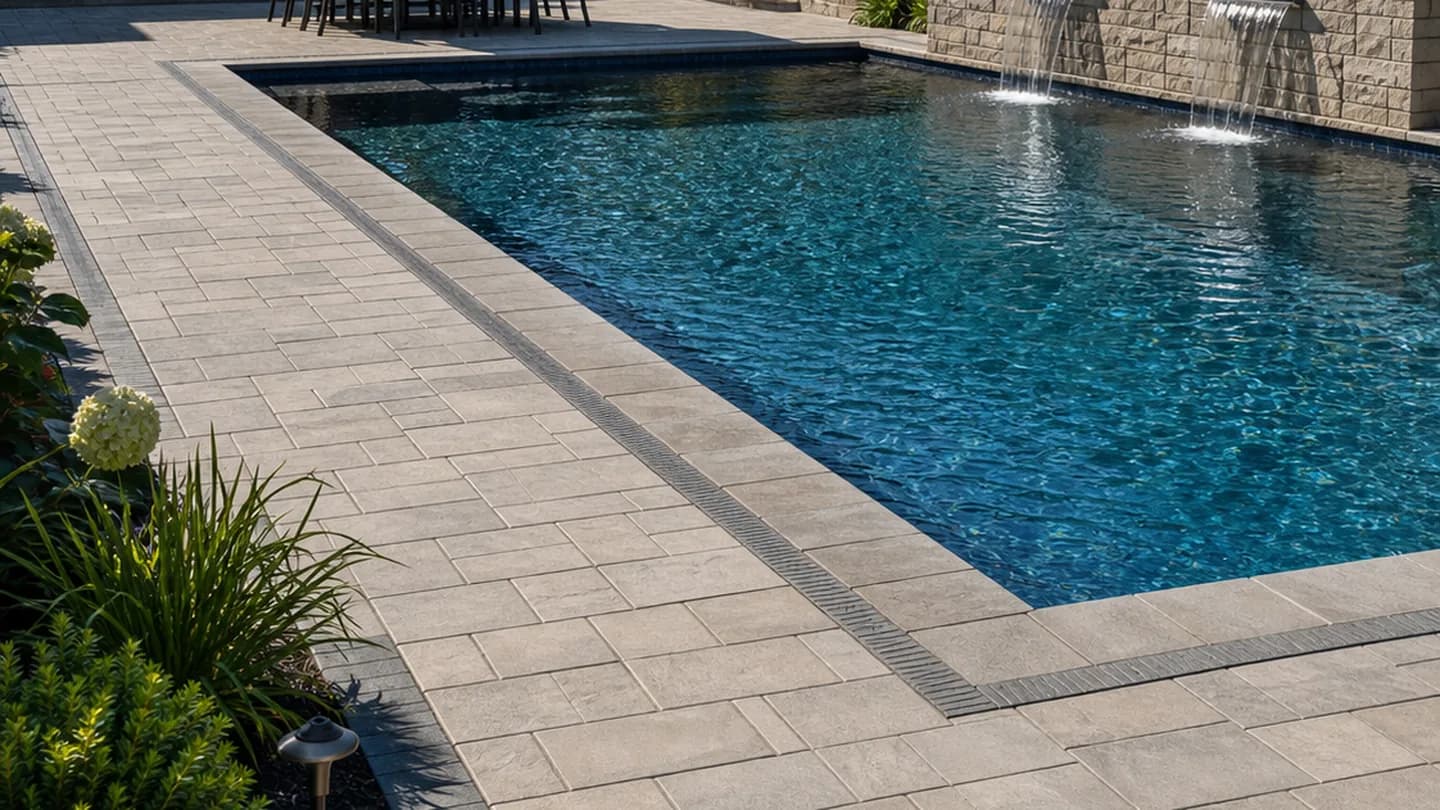
Concrete pavers are the most popular pool deck choice K&D sees in the Fredericksburg, Spotsylvania, and Stafford market. They handle freeze-thaw well because each individual paver can move slightly without cracking the deck as a whole. When Virginia's ground freezes and shifts in winter, a paver deck distributes the movement across the joints between units. A poured slab has no relief points and develops cracks where the stress concentrates.
Paver decks are installed on a compacted gravel and sand base that promotes drainage beneath the surface. Water that sits beneath a paver deck drains through rather than pooling and freezing against the bottom of the paver, which reduces frost heave. On clay soil sites in this region, that drainage base is particularly important.
The range of paver styles, sizes, and finishes is wide. Tumbled pavers have a more rustic, aged appearance. Clean-edged pavers read more contemporary. Large-format pavers create a different visual scale. K&D incorporates pavers into pool deck designs across both freeform resort-style pools and clean rectangular designs because the product works for both aesthetics.
Stamped Concrete
Stamped concrete is poured concrete that is pressed with textured patterns during the wet stage to mimic stone, slate, brick, or other materials. It is a popular choice for pool decks because it can be made to look like natural stone at a lower material cost than actual stone, and it is poured seamlessly around the pool coping for a monolithic finished look.
Stamped concrete performs well in Virginia when the base is properly prepared and the concrete is installed with adequate control joints placed at intervals that channel cracking to predictable lines. Without proper jointing, stamped concrete is susceptible to random cracking under freeze-thaw loading. A stamped concrete deck that cracks across a pattern panel looks bad and is more expensive to repair than fixing a displaced paver.
Sealing is required to protect stamped concrete and keep the color vibrant. In Virginia's climate, a quality penetrating sealer reapplied every two to three years maintains the surface and protects the color from UV fading. K&D specifies sealer type and application schedule as part of the deck design.
Travertine and Natural Stone
Travertine is a natural limestone that has become popular for pool decks in the premium market. Its open pore structure means it does not get as hot underfoot as dense concrete in direct sun, it has a natural non-slip texture, and the material's appearance is distinct from manufactured surfaces. Travertine pool decks are found on resort-style properties and homes where the landscaping and pool design together are designed to read as a high-end outdoor space.
Travertine does require maintenance. The porous surface needs sealing periodically. In Virginia's environment, the open pores can accumulate algae and debris if not cleaned regularly. Travertine also varies in quality by origin, and lower-grade travertine can pit and erode faster in freeze-thaw environments. K&D specifies travertine from suppliers whose product performs in this climate.
Other natural stone options, including bluestone, limestone, and certain granites, can be used for pool decks when properly selected for climate performance. Not all stone finishes are appropriate for pool decks. A polished stone surface becomes dangerously slippery when wet. K&D specifies honed or textured finishes for wet pool areas.
Brushed or Broom-Finished Concrete
Plain brushed concrete, also called broom finish, is the least expensive pool deck surface. The broom texture provides slip resistance. Brushed concrete is durable and functional, but it ages visibly and does not offer the design flexibility of pavers or stamped concrete. On clay soil sites with significant freeze-thaw loading, plain concrete slabs without careful jointing and base preparation are more likely to develop visible cracks over time.
If budget is the primary constraint and a functional deck is the goal, brushed concrete with proper base preparation and control joints every eight to ten feet performs adequately. K&D does not specify plain brushed concrete as the standard finish on its pool projects, but it acknowledges that it is a valid choice when the homeowner understands the tradeoffs.
Composite and Other Materials
Composite decking and hardwood decking are used around pools in some applications, typically for raised deck sections or pool surrounds rather than at-grade pool decks. Wood and composite at grade around a pool present drainage, slip, and maintenance challenges. K&D uses hardwood or composite decking selectively for covered patio structures, raised decks, and pergola bases adjacent to pool decks, not as the primary pool surround surface.
How Deck Choice Affects the Overall Pool Project
The deck is typically one of the larger line items in a pool project after the shell and equipment. Choosing pavers over stamped concrete, or adding travertine at a premium, affects the overall project budget. K&D designs the pool and deck together, so the material selection is part of the design conversation, not a separate decision made after the pool is built. The deck and coping are designed to complement each other, and the material choices affect the coping detail.
For coping and finish options that pair with the deck, see custom inground pools.
For how Virginia winters affect deck and pool construction, see pool construction freeze-thaw Virginia.
For how pool size affects how much deck area you will need, see what size inground pool should you build.
Start your pool and deck design at design your pool or request a quote at /get-a-quote.
More Questions
Frequently Asked Questions
Do concrete pavers get too hot to walk on in Virginia summers?
Lighter-colored concrete pavers in full sun get warm but are generally more comfortable than dark stone or dense concrete. Travertine and lighter natural stones stay cooler because of their open pore structure and lower heat absorption. Shaded deck sections stay comfortable regardless of material.
How does freeze-thaw affect pool deck concrete?
Water absorbed by concrete or trapped beneath a concrete slab freezes and expands in winter, then thaws and contracts. Repeated over a Virginia winter with 15 to 25 freeze-thaw cycles, this movement cracks concrete that does not have adequate control joints or a well-draining base. Pavers handle this better because each unit moves slightly at the joints.
Do I need to seal concrete pavers around a pool?
Sealing paver pool decks is optional but recommended. A sealer reduces water absorption, makes the surface easier to clean, and can enhance the color. In Virginia's climate, a quality sealer helps the paver surface resist the staining from algae and minerals that pool splashout introduces.
Can I add a pool deck to an existing pool?
Yes. K&D builds pool decks as additions to existing pools as well as in new pool projects. An existing pool may have existing concrete that needs removal before a new surface is installed, or the new deck surface can be installed over properly prepared existing work in some cases.
What is the most durable pool deck for Virginia?
Concrete pavers on a proper compacted gravel base are among the most durable for Virginia's specific combination of clay soil and freeze-thaw climate. They distribute movement across joints rather than cracking. Properly installed travertine performs well but costs more. Stamped concrete with good jointing is a close runner-up.
How much does a pool deck cost?
Pool deck cost in the Fredericksburg area varies by material, square footage, site conditions, and design complexity. K&D provides real pricing for your specific deck design during the project quote. Pavers and stamped concrete are typically mid-range; travertine and natural stone carry a premium.
Also From K&D
Explore More
Talk to a Local Pool Builder.
We build gunite and fiberglass pools across the Fredericksburg area. Ask us anything.