The Short Answer
Can you put an inground pool on a sloped or uneven yard in Virginia?
Yes. Inground pools can be built on sloped and uneven yards throughout Virginia. The slope determines the excavation approach, whether the pool needs a retaining wall, how the deck drains, and how the pool sits in the grade. Builders who work in this region see sloped lots regularly and design for them from the start.
Can you put an inground pool on a sloped or uneven yard? In Virginia, sloped lots are the rule rather than the exception, especially in Spotsylvania and Stafford where the Piedmont terrain rolls with natural grade changes. K&D builds pools on sloped lots regularly, and the design response to slope is well understood at this point.
What Slope Means for Pool Construction
Slope affects three things above all else: how much excavation is needed to create a level pool basin, whether a retaining wall is required on the high side, and how the deck drains. A yard that drops three feet from one side of the pool to the other is manageable. A yard that drops eight or ten feet changes the structural approach more significantly.
The pool itself must be level. The water surface will be horizontal regardless of what the yard around it does. That means on a sloped site, excavation goes deeper on the high side and less deep on the low side, and the pool deck must be designed to step or transition between grade levels without creating drainage that runs back toward the pool or the house.
Cut and Fill Approach
On a moderately sloped lot, K&D uses a cut and fill approach: cut into the high side of the slope to create the pool basin, and use that material to fill and raise the low side so the finished deck reads as a level platform around the pool. This approach works well for moderate slopes and avoids the cost of bringing in significant fill material.
The fill side must be properly compacted and engineered so the deck does not settle over time. Loose fill that is not compacted in lifts will compress under the deck's weight and leave you with cracked concrete. K&D compacts and grades the fill zones as part of the site prep, not as an afterthought.
When a Retaining Wall Is Required
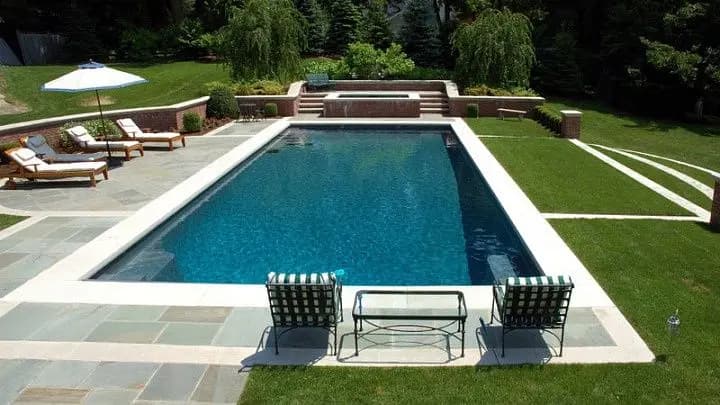
On lots with significant slope, the high side of the pool deck may require a retaining wall to hold the grade behind it. Retaining walls add to the project cost and complexity, but they also create a finished, intentional look: a raised patio level on the high side, a pool basin below, and a terraced outdoor space that makes good use of the grade.
The retaining wall must be engineered to handle the soil pressure behind it, particularly on clay soils that hold water and shift seasonally. K&D designs retaining walls as part of the pool project, not as a separate contract, so the drainage and structural requirements are planned together.
Drainage on Sloped Pool Lots
Slope means water moves. The drainage plan for a sloped pool site has to account for runoff from above the pool that might otherwise flow across the deck and into the pool area, and for water that collects in low spots near the pool structure. French drains, channel drains in the deck, and graded surfaces that direct flow away from the pool shell are all tools K&D uses depending on the site.
Poor drainage on a sloped pool lot is one of the most common issues K&D is called to evaluate on competitor builds. Water that pools at the base of a retaining wall or against the pool shell puts hydrostatic pressure on the structure over time. Planning drainage correctly at the outset is far cheaper than fixing it after the fact.
Access for Equipment and Excavation
Sloped lots can limit where excavation equipment can enter the property and how spoil is removed. On tight lots, the access route for a large excavator through a fence line or between structures has to be confirmed before design is final. K&D walks the site during the design phase to identify access constraints and plans the excavation accordingly.
How Slope Affects Cost
Moderate slope adds cost primarily through additional excavation, fill work, and deck complexity. Significant slope that requires a retaining wall adds both the wall cost and the engineering cost. The site walk during design gives K&D the information to quote the slope-specific work accurately rather than discovering it after excavation begins.
Your Sloped Lot Can Be an Asset
Some of the most striking pool designs K&D builds are on sloped lots, where the grade is used to create elevated pool decks, tiered outdoor living areas, and views that a flat lot cannot offer. A slope is not a liability if it is worked with rather than fought. Visit /custom-inground-pools or /get-a-quote to start the site conversation. For related topics, see /building-a-pool-on-clay-soil-virginia and /pool-construction-freeze-thaw-virginia.
More Questions
Frequently Asked Questions
How steep is too steep for a pool?
There is no universal threshold. Very steep lots may require extensive retaining walls or site modifications that push the project out of budget. K&D evaluates each site and will tell you honestly what your slope requires and what it costs before you commit.
Does a sloped lot require a retaining wall?
Not always. Moderate slopes are handled with cut and fill grading. Significant slopes, generally more than a few feet of grade change across the pool footprint, typically require a retaining wall on the high side.
Can you build a pool on a lot with trees and slope combined?
Yes, but root systems, canopy coverage, and tree removal requirements add to the planning complexity. K&D assesses tree locations, root zones, and canopy shade during the design walk before committing to a layout.
How does a sloped deck drain without flooding the pool?
The deck is graded away from the pool coping, and channel drains or French drains are placed to intercept runoff before it reaches the pool. K&D designs the drainage as part of the deck plan, not as an add-on.
Will slope affect my permit application?
The site plan in the permit application shows the existing and proposed grades. Retaining walls require their own structural drawings. K&D includes all of this in the permit package.
How do I know if my lot has enough flat area for a pool?
The relevant question is whether the lot has enough area, not whether it is already flat. K&D walks the site and confirms what the finished graded layout would look like before you invest in a design.
Also From K&D
Explore More
Talk to a Local Pool Builder.
We build gunite and fiberglass pools across the Fredericksburg area. Ask us anything.